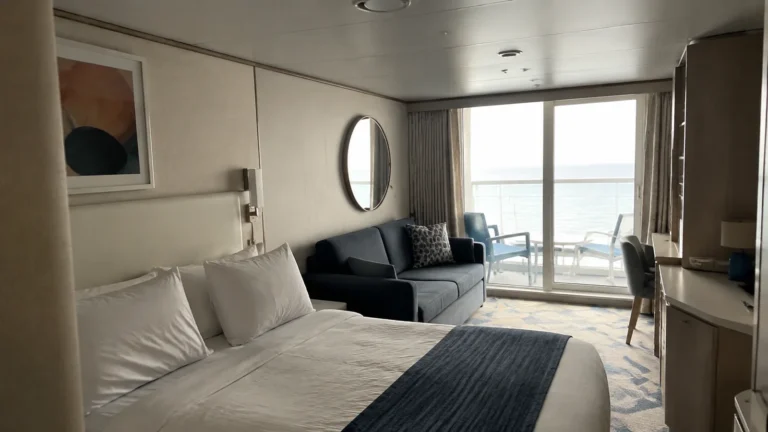
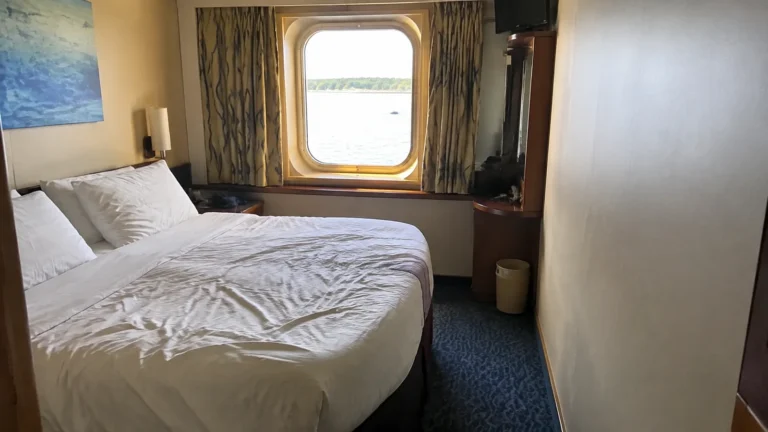
Cruise Cabins to Avoid: 14 Booking Red Flags
A cruise cabin is only “bad” when its location or layout clashes with the way you travel. These are the cabins I would inspect before paying, the tradeoffs that actually matter, and the safer alternatives when sleep, motion, privacy, space, or accessibility is your priority.

There Is No Universal Worst Cabin
A late sleeper may love a room above the nightclub, while a parent may gladly accept pool-deck noise for a short walk with children. The goal is not to eliminate every imperfection; it is to avoid paying for a problem you already know will bother you.
This is a fleet-wide decision guide, not a list of suspect room numbers. Once you know your red flags, use the cruise line’s plan for the exact vessel and sailing period because refits, venue changes, and even close sister ships can differ.
The official Royal Caribbean deck-plan library, for example, lets travelers choose a ship and shows plans tied to sailing-date ranges. That date selector is a useful reminder that a screenshot from an old review may no longer match your cruise.
1. Cabins Directly Below the Pool Deck
The problem is rarely swimmers alone. Loungers may be moved early, carts roll across hard surfaces, deck parties run late, and shaded overhangs can affect the balcony below.
Light sleepers should look one or two decks lower, ideally with another full deck of cabins overhead. Pool-focused families may decide the short elevator-free trip is worth occasional scraping and foot traffic.
2. Cabins Below Buffets and 24-Hour Food Areas
A buffet can create chair movement, cleaning, dropped objects, and cart noise outside normal meal times. A quiet-looking patch on the plan may also hide a galley, dishwashing area, or service corridor that the public map does not label.
If the ceiling above your prospective room sits under tables or a back-of-house boundary, ask the cruise line what occupies that exact footprint. Moving a few cabins sideways can be more effective than changing decks.
3. Cabins Above or Below Nightclubs, Theaters, and Lounges
Bass travels through structure, so a cabin does not need to share a wall with a venue to hear a late show or rehearsal. Theater noise can also arrive during afternoon sound checks, while lounges may host music, games, or private events not obvious from the marketing description.
Early sleepers should create at least one residential-deck buffer from a major entertainment room. Travelers who stay out through the final set may find these cabins discounted and perfectly practical.
4. Cabins Near Crew Doors and Service Spaces
An unlabeled white or gray block beside a cabin can contain storage, housekeeping equipment, a pantry, or crew access. The risk is not the crew themselves; it is repeated door movement, carts, deliveries, and work that starts before many passengers wake.
No public deck plan exposes every operational space, so certainty is impossible before boarding. I would be most cautious when a room sits at the end of a short corridor beside a blank block or directly opposite a service door shown in official cabin photos.

5. Cabins Opening Into a Busy Elevator Lobby
Elevators are not automatically noisy, and a cabin 30 feet down the hall can be wonderfully convenient. The more credible concern is a door facing the lobby where late-night conversations, waiting groups, and passing traffic collect.
Travelers with limited walking tolerance may reasonably prioritize this location. Light sleepers can keep the convenience by choosing several doors away, around a corridor bend, rather than banishing the entire elevator bank.
6. Extreme Forward Cabins for Motion-Sensitive Travelers
Pitch is generally felt more strongly toward the bow and stern than near the ship’s center, and height can amplify the sensation. A high, far-forward cabin is therefore the combination I would avoid first when seasickness is a known problem.
Start lower and closer to midship, then discuss prevention with a clinician before traveling because room location cannot prevent motion sickness. The CDC’s cruise-travel guidance specifically advises susceptible passengers to ask a healthcare provider about medication.
Forward rooms can still be excellent for fit travelers who value dramatic views and quiet hallways. On some ships, however, bow thrusters, anchor operations, or early docking activity can produce vibration and sound near arrival time.
7. Extreme Aft Cabins When Vibration Matters
Aft-facing balconies earn loyal fans for wake views, deeper outdoor space on some ships, and low corridor traffic. Their possible costs include vibration during maneuvering, a longer walk, structural framing, and occasional soot or exhaust depending on ship design and conditions.
This is a category where exact ship evidence matters more than general warnings. Check recent reports for the same room or vertical stack, but treat one calm sailing or one dirty balcony as evidence rather than a permanent guarantee.
8. Connecting Cabins for Light Sleepers
The locked connecting door can transmit more conversation and television noise than a standard wall. Families booking both rooms gain a useful shared arrangement, but unrelated neighbors may make the same feature feel like a thinner barrier.
If you do not need the connection, look for the deck-plan symbol and choose a non-connecting room in the same area. If adjoining rooms are essential, confirm both cabin numbers on one booking and ask whether the interior door, balcony divider, or both can connect.
9. Obstructed-View Cabins Booked at Full-View Expectations
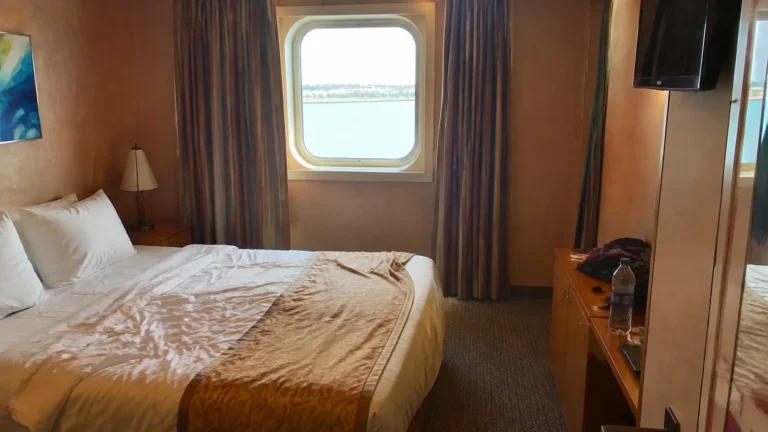
“Ocean view” can include a lifeboat, davit, deck machinery, railing, or structure between you and open water. Some obstructions cover only the lower sightline and create terrific value, while others dominate the window or balcony.
Read the precise category name and legend instead of trusting a generic balcony photo. Carnival’s current promotion terms even state that some guarantee ocean-view or balcony bookings may receive partially or fully obstructed views, which shows why category language matters.
Search for recent photos of the exact cabin number before rejecting it. A discounted partial view can beat an inside cabin for daylight, but it is a poor choice when an uninterrupted horizon is the reason you paid more.

10. Promenade, Boardwalk, and Interior-Facing Rooms
These rooms provide light and people-watching without a conventional ocean-facing view, but they can trade privacy for spectacle. Opposite cabins, public walkways, shows, music, and venue lighting may remain visible or audible long after you return.
Keep curtains closed when changing and check the scheduled entertainment beneath or outside the room. Choose an ocean-facing cabin if quiet water views are central to the purchase, since “balcony” does not always mean private sea frontage.
11. Cabins Beside Family and Teen Areas
Youth venues create bursts of hallway traffic around opening, pickup, and evening program times. The same location can be a major advantage for parents whose children use the club every day.
Adults seeking quiet should check for kids’ clubs, arcades, sports courts, waterslides, and family lounges on the same deck and the deck above. Do not assume an adults-only venue nearby makes the whole surrounding corridor adult-only.
12. Cabins With Public Decks Looking Down on the Balcony
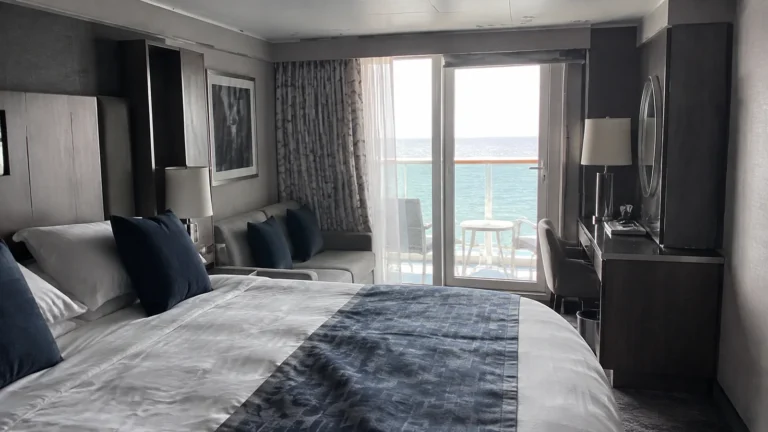
A stepped ship profile can leave lower balconies visible from railings above, and promenade paths may pass directly outside some windows. Other balconies sit beneath deep overhangs that improve shade but reduce sky, sun, and upward sightlines.
Neither design is inherently bad, but the difference matters for privacy, photography, and sun seekers. Use exterior ship photos alongside the plan because a top-down diagram cannot show overhang depth or who can see into the outdoor space.
13. A Guarantee Cabin When Location Matters
A guarantee, sometimes labeled GTY or “We Pick,” secures a category type while letting the cruise line assign the exact number and location. Royal Caribbean says assignment can occur at its discretion any time up to port check-in on its official guarantee-stateroom page.
That trade can be smart when the savings are meaningful and you would truly accept every location in the promised category. It is the wrong gamble if you need nearby family cabins, low motion, a non-connecting room, a specific view, or distance from nightlife.
Price the exact-cabin option before assuming GTY is a bargain, and never budget around a hoped-for upgrade. If the assignment changes, repeat the deck-plan check rather than assuming the new room is equivalent because the broad category stayed the same.
14. A Cabin Whose Layout Does Not Fit Your Group
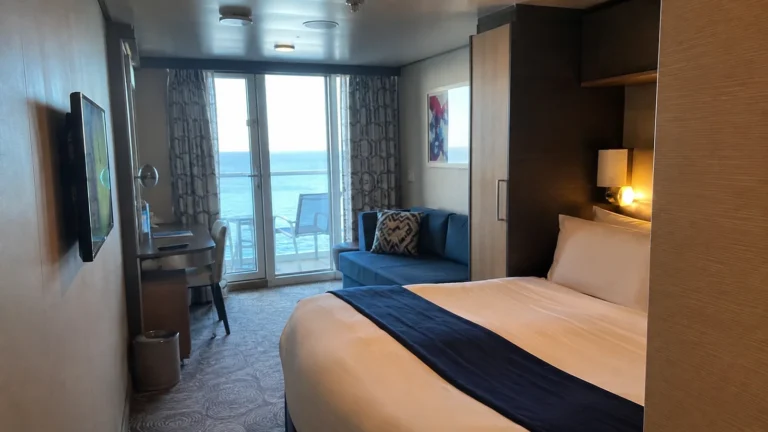
Occupancy does not prove comfort. A four-person cabin may use a sofa bed, pull-down berths, or both, leaving little floor space at night and a bed arrangement that may not suit four adults.
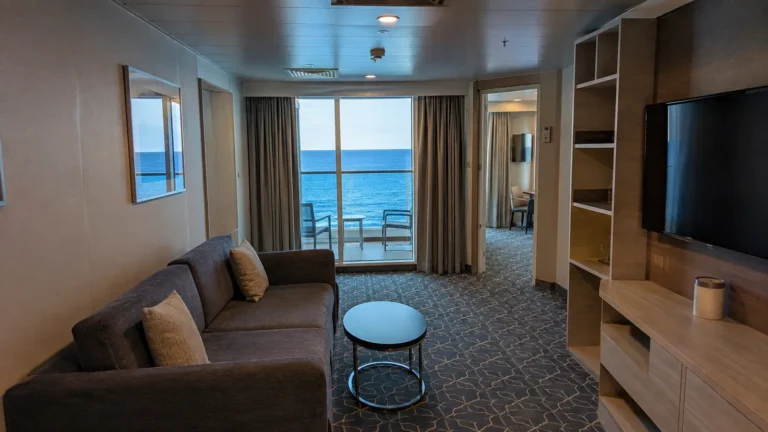
Confirm square footage, bed conversion, balcony size, shower or tub, storage, outlets, and whether the cabin door or bathroom has a raised threshold. A beautiful suite can still fail if its second sleeping area, bathroom access, or nighttime circulation does not work for your party.

Accessible Cabins Are a Separate Decision
Do not avoid an accessible cabin because a generic list calls its layout unusual, and do not reserve one merely to gain floor space. These rooms are designed around functional needs and may include wider doors, turning space, grab bars, accessible routes, and roll-in showers.
Carnival distinguishes fully accessible, single-side-approach, and ambulatory-accessible cabins in its current accessibility information. Travelers who need these features should confirm the exact cabin, bed-side clearance, bathroom setup, balcony threshold, equipment storage, and route to essential venues with the cruise line’s access team.
Cabin Myths That Waste Good Options
Do not automatically reject every room near an elevator, every cabin on a low deck, or every obstructed view. Those locations can offer convenience, stability, daylight, or savings with little meaningful downside for the right traveler.
Port versus starboard is also not a reliable way to guarantee a land view in every port, since berth and docking direction can change. Pay extra for a side only when the itinerary offers a specific scenic reason and the line describes what is actually promised.
A higher deck is not automatically an upgrade either. It may shorten the walk to pools while increasing motion or placing the cabin beneath public space, so compare the complete location rather than the deck number.
My Safest Default Cabin
For a sleep-first traveler without special access needs, I would start with a non-connecting cabin near midship on a lower-middle or middle deck, with ordinary cabins directly above and below. I would then check that it does not face an elevator lobby, service door, or blank operational space.
That default is deliberately boring, and boring is useful when the room’s main job is reliable rest. The best cruise rooms by traveler type can help refine the category after you control the location risks.
A Five-Minute Cabin Check Before You Pay
- Open the cruise line’s current plan for the exact ship and sailing dates.
- Find the cabin, then inspect the same footprint one deck above and below.
- Decode every symbol for connections, occupancy, obstruction, and accessibility.
- Check nearby service blocks, public stairs, elevator lobbies, and venue entrances.
- Verify the category wording, bed setup, dimensions, view, and balcony type.
- Compare the assigned-cabin price with the guarantee rate.
- Save the plan version and confirmation showing the selected room number.
The 12-step cruise floor-plan check goes deeper into legends, vertical stacking, and hidden boundaries. Use a ship-specific cabin article only after this broad filter, because exact room reports are most useful when the vessel, plan version, and evidence are identified.
Cabins to Avoid by Ship
If you already know your ship, jump straight to its guide below. I keep these separate because the exact deck, venue, view, and cabin number matter much more than a generic warning.
Carnival Cruise Line
- Carnival Breeze
- Carnival Celebration
- Carnival Elation
- Carnival Freedom
- Carnival Glory
- Carnival Legend
- Carnival Liberty
- Carnival Magic
- Carnival Panorama
- Carnival Pride
- Carnival Radiance
- Carnival Splendor
- Carnival Sunshine
- Carnival Valor
- Carnival Vista
Royal Caribbean
- Allure of the Seas
- Anthem of the Seas
- Brilliance of the Seas
- Freedom of the Seas
- Harmony of the Seas
- Icon of the Seas
- Independence of the Seas
- Jewel of the Seas
- Legend of the Seas
- Liberty of the Seas
- Mariner of the Seas
- Oasis of the Seas
- Odyssey of the Seas
- Ovation of the Seas
- Quantum of the Seas
- Radiance of the Seas
- Rhapsody of the Seas
- Serenade of the Seas
- Star of the Seas
- Symphony of the Seas
- Vision of the Seas
- Wonder of the Seas
Norwegian Cruise Line
- Norwegian Bliss
- Norwegian Dawn
- Norwegian Encore
- Norwegian Escape
- Norwegian Getaway
- Norwegian Jade
- Norwegian Jewel
- Norwegian Joy
- Norwegian Luna
- Norwegian Pearl
- Norwegian Star
- Norwegian Sun
Princess Cruises
- Coral Princess
- Discovery Princess
- Emerald Princess
- Enchanted Princess
- Grand Princess
- Majestic Princess
- Regal Princess
- Ruby Princess
- Sapphire Princess
- Star Princess
Celebrity Cruises
- Celebrity Apex
- Celebrity Constellation
- Celebrity Eclipse
- Celebrity Edge
- Celebrity Silhouette
- Celebrity Solstice
- Celebrity Summit
- Celebrity Xcel
MSC Cruises
P&O Cruises
Holland America
Marella Cruises
Disney Cruise Line
Cunard
Other ships

What to Do After Booking
Recheck the cabin number after any upgrade bid, fare adjustment, ship swap, or guarantee assignment. If the line moves you, ask whether another room in the new category is available, but do not assume a free change is permitted.
Add the cabin number and any accessibility requests to your cruise planning record. For first-time travelers, these first-cruise booking checks cover the other details that deserve confirmation before final payment.
The best cabin is not the most expensive room or the highest deck. It is the one whose known tradeoffs fit your sleep schedule, body, group, itinerary, and budget before the cancellation penalties make changing course difficult.