Brilliance of the Seas Rooms to Avoid: Exact Cabin Guide
Brilliance of the Seas has a wonderfully manageable layout, but several cabins come with tradeoffs that a color-coded booking screen can hide. Start with the officially obstructed balcony categories, then look at Deck 7 rooms above entertainment and Deck 10 rooms beneath the pool and buffet.
The short list
- Avoid for an unobstructed balcony: the 1E and 2E cabins on Decks 7, 8, and 9
- Check for evening sound: forward Deck 7 rooms above the Pacifica Theatre and aft Deck 7 rooms above lounges
- Check for overhead activity: Deck 10 rooms below the fitness center, pools, Park Café, and Windjammer
- Consider motion carefully: the highest forward rooms and farthest-aft balconies
- Inspect the symbols: connecting doors, occupancy icons, and accessible layouts
None of the location warnings makes a room universally bad. A discounted obstruction can be a smart buy for fresh air, and a cabin over the theater can suit someone who attends every late show.
How this guide separates facts from possibilities
Royal Caribbean’s current Brilliance deck plans cover sailings from April 19, 2026, through April 18, 2027. They identify every cabin category, room number, public venue, connection, occupancy marker, accessibility symbol, and obstructed-view category.
I compared each accommodation deck vertically with the level above and below. The plan proves that cabin 1030 sits beneath the Solarium area, for example, but any claim about chair or footstep sound remains a conditional planning judgment.
Brilliance is a Radiance Class ship with 90,090 gross tons and approximately 2,142 guests at double occupancy, according to Royal Caribbean’s current fleet overview. Its smaller scale makes walking easier than on a megaship, but bow, stern, and deck height still matter.
The officially obstructed balcony cabins
Royal Caribbean labels categories 1E and 2E “Obstructed Ocean View Balcony.” If a completely open outlook is nonnegotiable, these are the cabins to remove first because the limitation is part of the official category, not a guest’s opinion.
Deck 7 obstructed balconies
On the port side, the official 1E and 2E block includes even-numbered cabins 7048 through 7094 and 7108 through 7150, plus 7164 and 7170. On starboard, it includes even-numbered 7548 through 7608 and 7610 through 7650, plus 7664 and 7670.
That wording matters because the numbers are not one continuous run. Cabins between the printed blocks do not share the same category, so never convert the set into a blanket “all of Deck 7” warning.
Much of the midship obstruction relates to the ship structure and the top of lifeboat equipment below, which can limit the straight-down view more than the horizon. Royal’s category promises only an obstructed view; the plan does not quantify how many degrees each balcony loses.
These cabins can be excellent value for a traveler who wants outdoor air and daylight at a lower balcony price. They are poor matches for someone booking specifically to photograph the water directly alongside the hull.
Deck 8 obstructed balconies
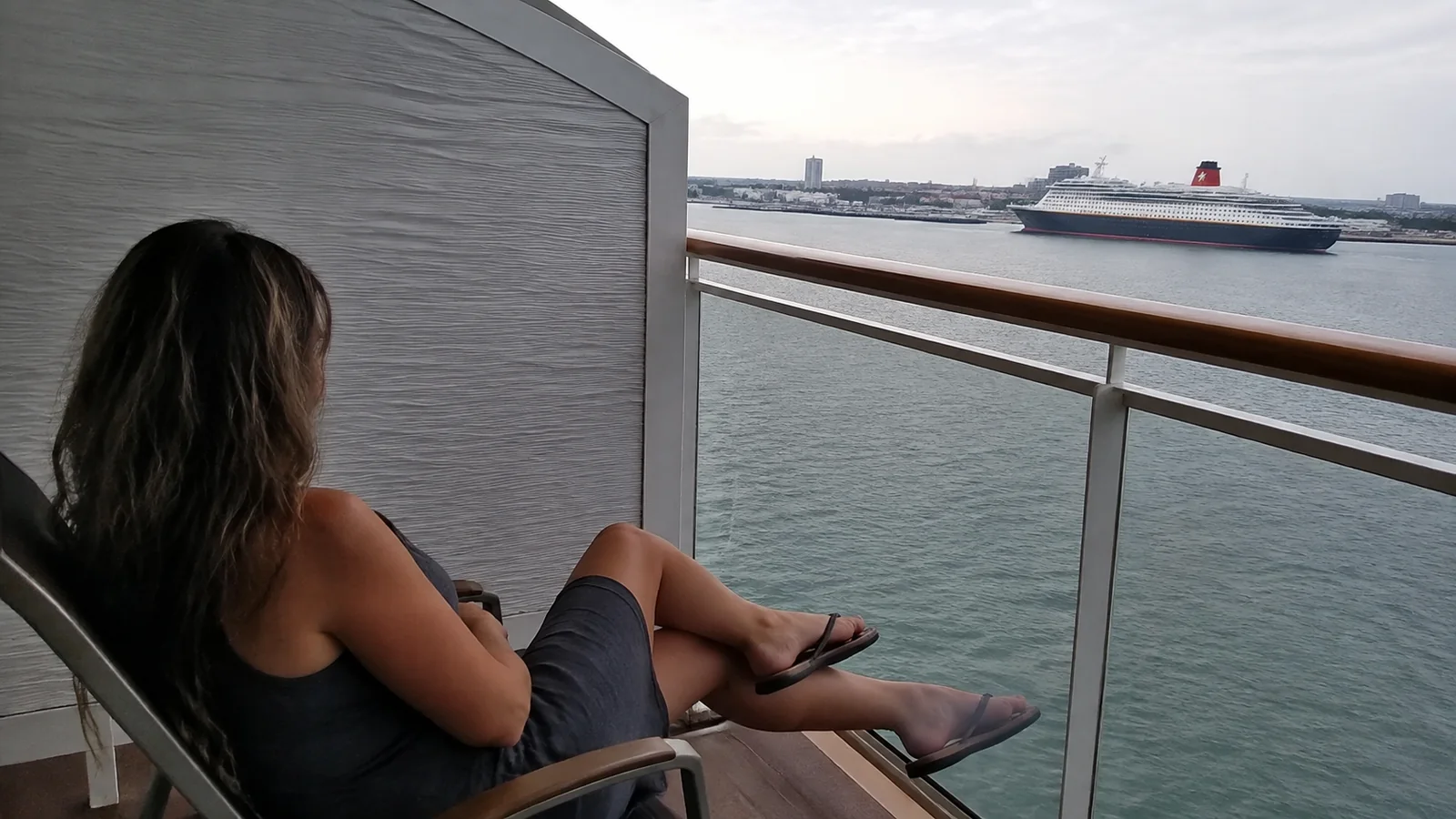
The official obstructed category appears on 8058, 8060, 8558, 8560, 8162, 8164, 8662, and 8664. These isolated rooms are easy to overlook because most neighboring Deck 8 balconies carry standard rather than obstructed category colors.
Compare 8056 with 8058 or 8562 with 8560, but confirm price, occupancy, connection, and category before switching. A nearby room may remove the official obstruction while adding a connecting door or changing bed capacity.
Deck 9 obstructed balconies
Deck 9’s officially obstructed set is 9048, 9050, 9252, 9254, 9652, and 9654. The aft four sit beside the ship’s stern curve, while 9048 and 9050 are in the forward-to-midship transition.
Do not assume every sunset-facing cabin is obstructed. The aft-facing rooms across the stern use separate categories, and their view, balcony geometry, walking distance, and motion tradeoffs deserve their own comparison.
Deck 7 cabins above the Pacifica Theatre
Cabins 7000 through 7046 on port and 7500 through 7546 on starboard occupy the forward Deck 7 block above the Deck 6 Pacifica Theatre. Rooms closest to the stage and seating footprint have the clearest structural reason for an early sleeper to pause.
Possible disturbances include music, bass, rehearsals, applause, and crowds leaving a performance. The deck plan cannot prove which room hears what, and a night owl may value the one-flight trip home.
The high-numbered interior rooms 7529 through 7535 sit within the same forward block, though their exact exposure differs from an outside cabin over the theater’s edge. Choose Deck 8 in the same section for cabins above and below, then recheck elevator distance and connection symbols.
Deck 7 over the casino, bars, and restaurants
Midship Deck 7 cabins 7048 through 7106 and 7548 through 7608 align broadly over the casino, Vintages, Schooner Bar, and nearby circulation on Deck 6. This is a mixed footprint, so it would be misleading to promise identical sound in every room.
Music and conversation are more plausible over bar areas, while casino and elevator traffic may matter near the central lobby. Guests who stay out late may prefer this convenient position despite the evening activity below.
Aft Deck 7 cabins 7108 through 7170 and 7610 through 7670 lie above specialty dining and the Colony Club, Jakarta Lounge, and Singapore Sling’s area. The lounge and performance portions are the stronger late-night concern, while a restaurant alone is not an automatic noise problem.
Deck 8 offers the most direct quiet-location alternative because it is largely sandwiched between cabin decks. Avoid the eight officially obstructed Deck 8 rooms if the view also matters.
Deck 10 below the fitness, pool, and buffet deck
Deck 10 is the other level requiring a careful vertical check because Deck 11 is almost entirely public space. Different stretches sit beneath very different activities, so “avoid all of Deck 10” throws away useful choices.
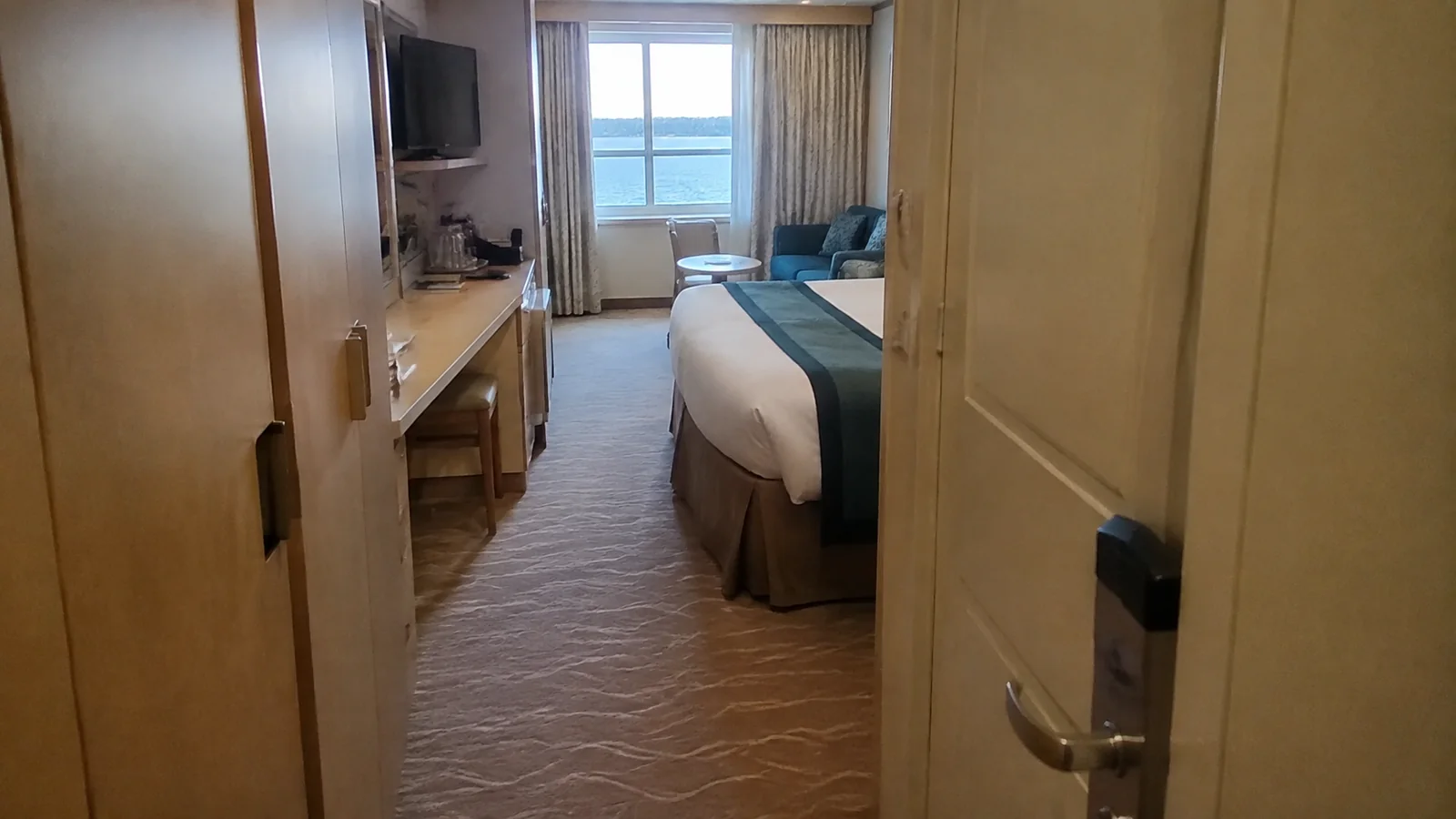
1000 through 1026 and 1500 through 1526
These forward rooms sit below the Vitality at Sea Spa and Fitness Center footprint. Exercise activity, equipment, doors, and morning arrivals are possible overhead concerns, especially for a late sleeper.
The forward position may also feel more active in rough water than a lower midship cabin. Spa access is wonderfully convenient, so this is a preference trade rather than a categorical rejection.
1028 through 1056 and 1528 through 1556
This block aligns beneath the Solarium, indoor pool, Park Café, bar, and beginning of the main pool area. Potential overhead sound includes loungers, footsteps, service activity, and guests using the area early or late.
Cabins 1028 and 1528 are accessible Junior Suites, not ordinary rooms with bonus floor space. Travelers who need their features should verify the exact layout, while other guests should leave limited accessible inventory available whenever possible.
1060 through 1098 and 1560 through 1598
These rooms continue beneath the pool deck, movie-screen zone, art gallery, and forward portion of the Windjammer area. Exposure changes significantly along the corridor, with pool activity more relevant forward and food-service circulation more relevant aft.
Cabin 1062 beneath open deck is a different proposition from 1098 beneath buffet-related space. Use the exact vertical match rather than treating a long number range as one sound profile.
Aft rooms 1100 through 1106 and 1600 through 1604
The stern cabins sit below the Windjammer Café and its outdoor section. Breakfast setup, chairs, carts, and foot traffic are plausible overhead issues, while the far-aft position adds a separate possibility of stern vibration or movement.
The reward is an aft outlook and a short walk to food one deck up. Choose these for the view and convenience, not because anyone can promise a silent ceiling.
Forward and aft motion considerations
A lower midship cabin is generally the safer location for someone who already knows motion triggers nausea. High-forward Deck 10 rooms are farther from the ship’s center of motion than midship rooms on Decks 3, 4, 8, or 9.
Aft-facing cabins such as 7172 through 7176, 7672 through 7674, 8168 through 8176, 8668 through 8678, and 9256 through 9660 offer special wake views. They can also involve longer walks and more perceptible stern motion, depending on sea state and speed.
None of those exact rooms is being labeled noisy without evidence. Their location is structural; motion and vibration remain voyage-dependent possibilities.
The same location logic appears in the cruise cabin warning checklist. It helps separate a real deck-plan feature from a dramatic review written during one rough night.
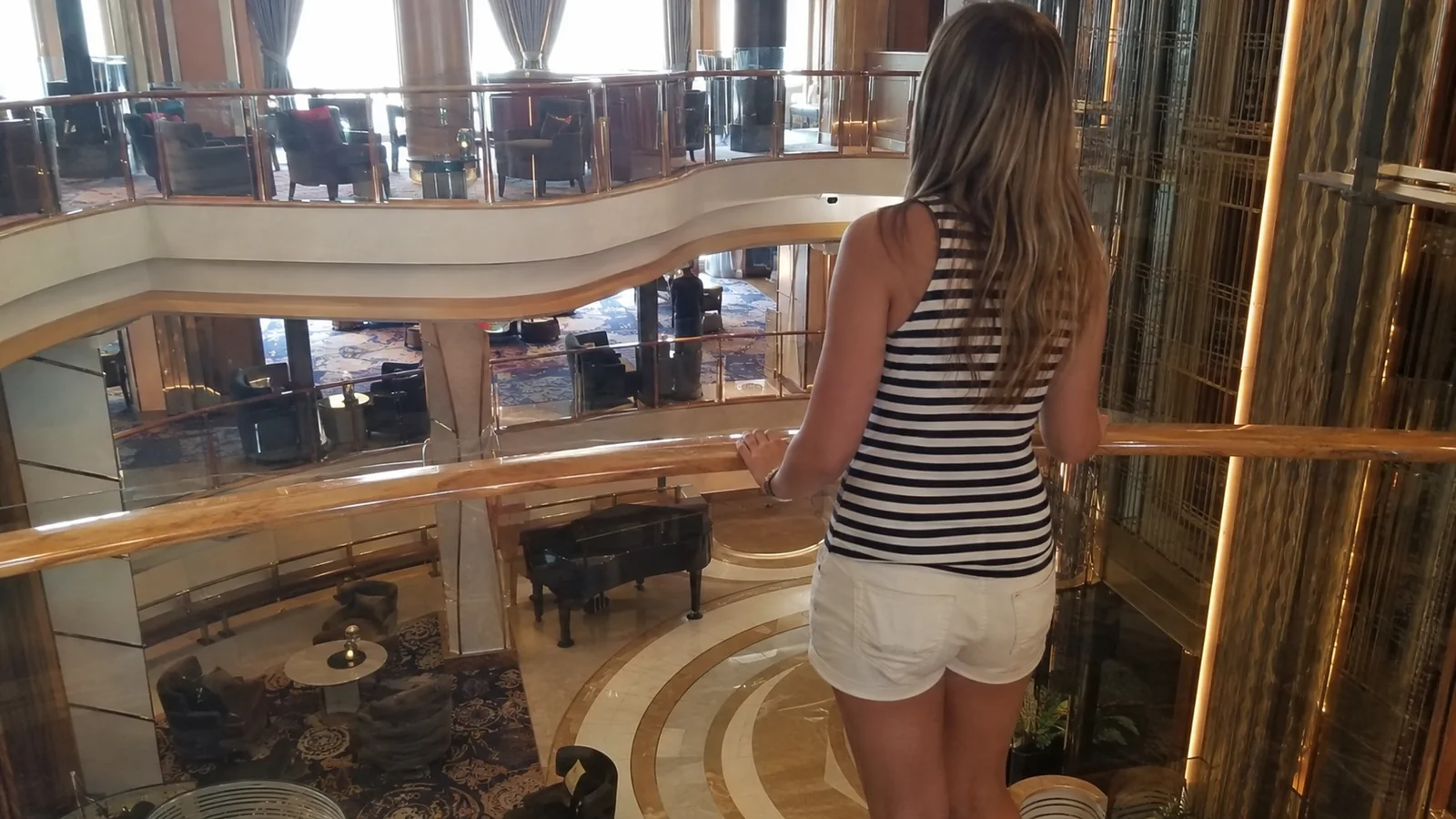
Connecting doors and occupancy symbols
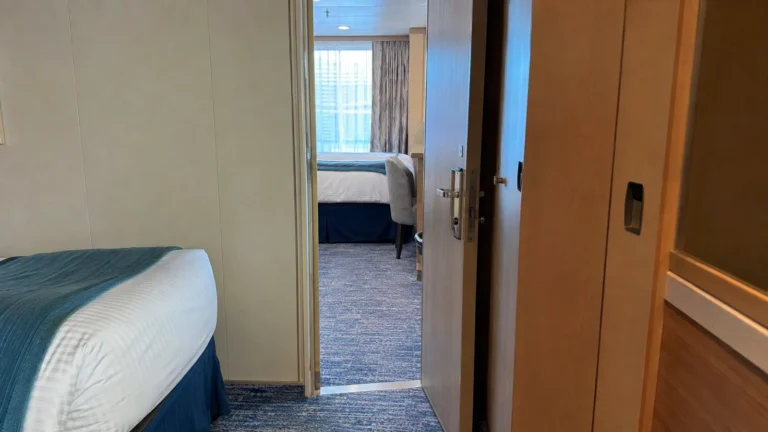
Royal marks connecting rooms with opposing doorway arrows. That setup is valuable when your group books both sides, but an extra door may transmit more conversation or television than an uninterrupted wall.
A connecting cabin is not guaranteed to be loud because neighbor behavior matters far more than a tiny symbol. Reject it only when silence is a top priority and an equivalent nonconnecting room is available.
Triangles, stars, and other occupancy symbols show rooms that can hold additional guests. More capacity can mean a sofa bed or Pullman arrangement, so compare the precise bed description with how your party actually sleeps.
The official Brilliance room page confirms that select cabins connect and that accommodations exist for special needs. A category name alone does not reveal the configuration of every numbered room.
Accessible-cabin etiquette and practical checks
The plan marks accessible rooms with a wheelchair symbol, including options in multiple locations and price levels. Guests who need a roll-in shower, turning space, wider access, or other features should have Royal Caribbean confirm the exact numbered cabin before payment.
Do not select an accessible cabin as a clever way to obtain more floor area. Its bathroom, storage, thresholds, and furniture placement support specific access needs and may differ from the standard layout you expected.
If Royal assigns one during an inventory change, ask what features differ and whether a traveler with a documented need could take priority. Courtesy matters because accessible cabin supply is limited even when a booking screen temporarily shows availability.
Better areas for common priorities
For a light sleeper
Start with a nonconnecting cabin on Deck 8 or Deck 9, with rooms above and below. Exclude the official 1E and 2E numbers when an open view matters, and stay a few doors from elevator lobbies.
For a motion-sensitive guest
Look lower and closer to midship on Deck 3 or Deck 4, accepting that many choices are Ocean View or Interior. The best cabin category is the one you can comfortably use, not the one with the highest deck number.
For a balcony bargain hunter
Price the 1E and 2E rooms against the closest standard balcony. If the savings are meaningful and you mainly want daylight and private outdoor air, the obstruction may be a reasonable compromise.
For travelers minimizing walking
Cabins near the central elevators reduce long corridors, but they also attract more passing guests. The best-room decision framework helps weigh mobility, sleep, view, and motion instead of chasing one universal answer.
A five-minute check before booking
- Use the plan version matching your sailing dates.
- Locate the exact room above, below, and across the hall.
- Confirm whether the category itself says “obstructed.”
- Check connection, occupancy, and accessibility symbols.
- Compare an alternative at least one venue footprint away.
A guarantee fare can remove much of this control because Royal assigns the cabin. The practical cabin-booking strategies are most useful before you trade location choice for a lower price.
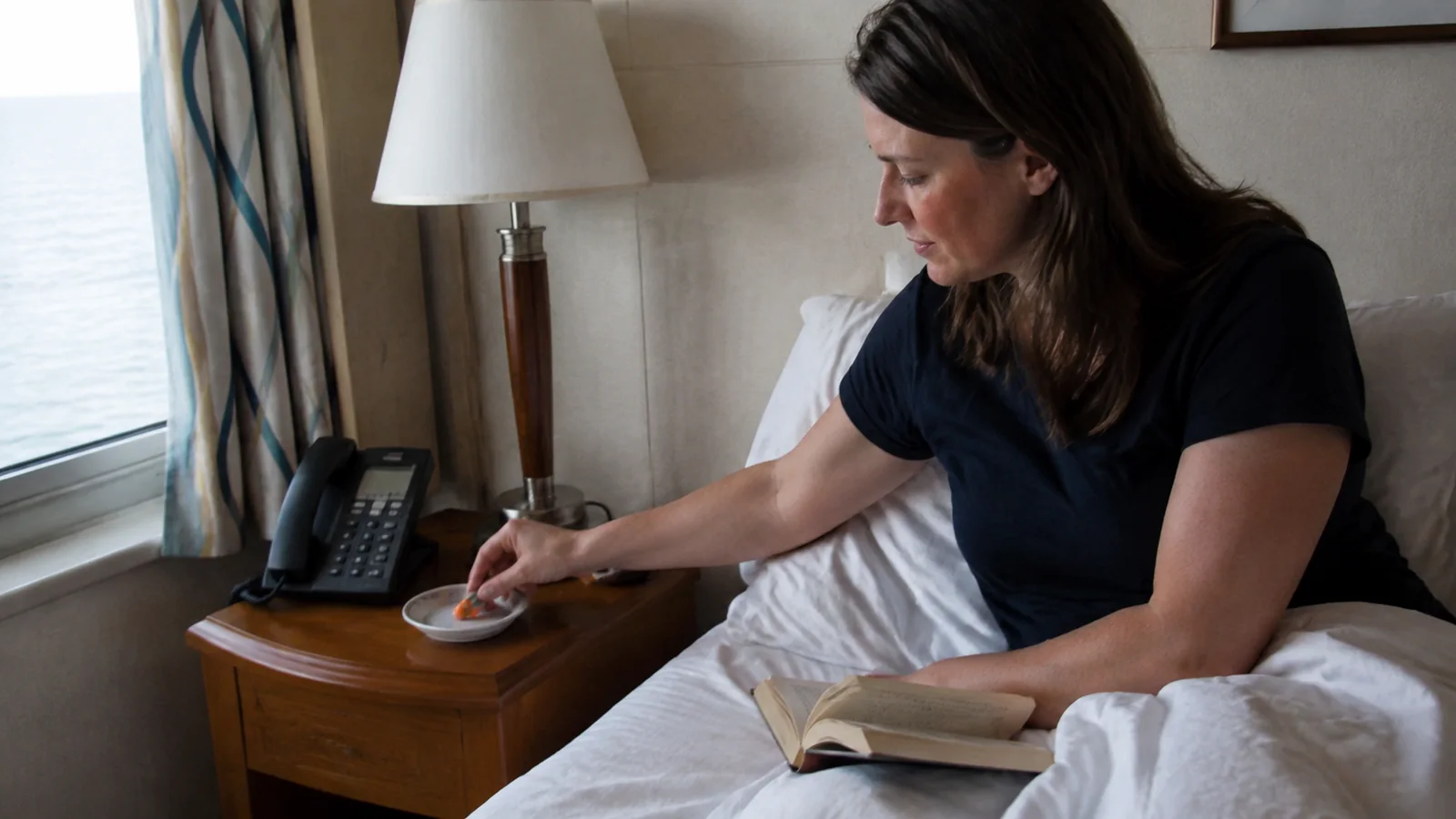
The bottom line
Avoid Royal’s 1E and 2E cabins when a clear balcony view is essential, and inspect Deck 7 or Deck 10 carefully when sleep is the priority. Those warnings rest on official category labels and visible venue adjacency, while noise and motion remain conditional.
For the simplest quiet-location bet, choose a nonconnecting, non-obstructed cabin near midship on Deck 8 or 9. Choose differently when a discounted balcony, short walk, aft wake, or accessible configuration matters more to your trip.