Cape Town Kayaking: Where to Paddle and How to Choose Safely
Cape Town gives you several completely different kayaking days within one city. You can paddle near penguin habitat in False Bay, trace the cliffs outside Hout Bay, watch Table Mountain rise behind Sea Point, or stay on a sheltered canal when the ocean is not cooperating.
Which Cape Town kayaking trip should you choose?
- Choose Simon’s Town for the best chance of seeing African penguins from the water.
- Choose Hout Bay for mountain cliffs, a working harbor, and possible seal sightings.
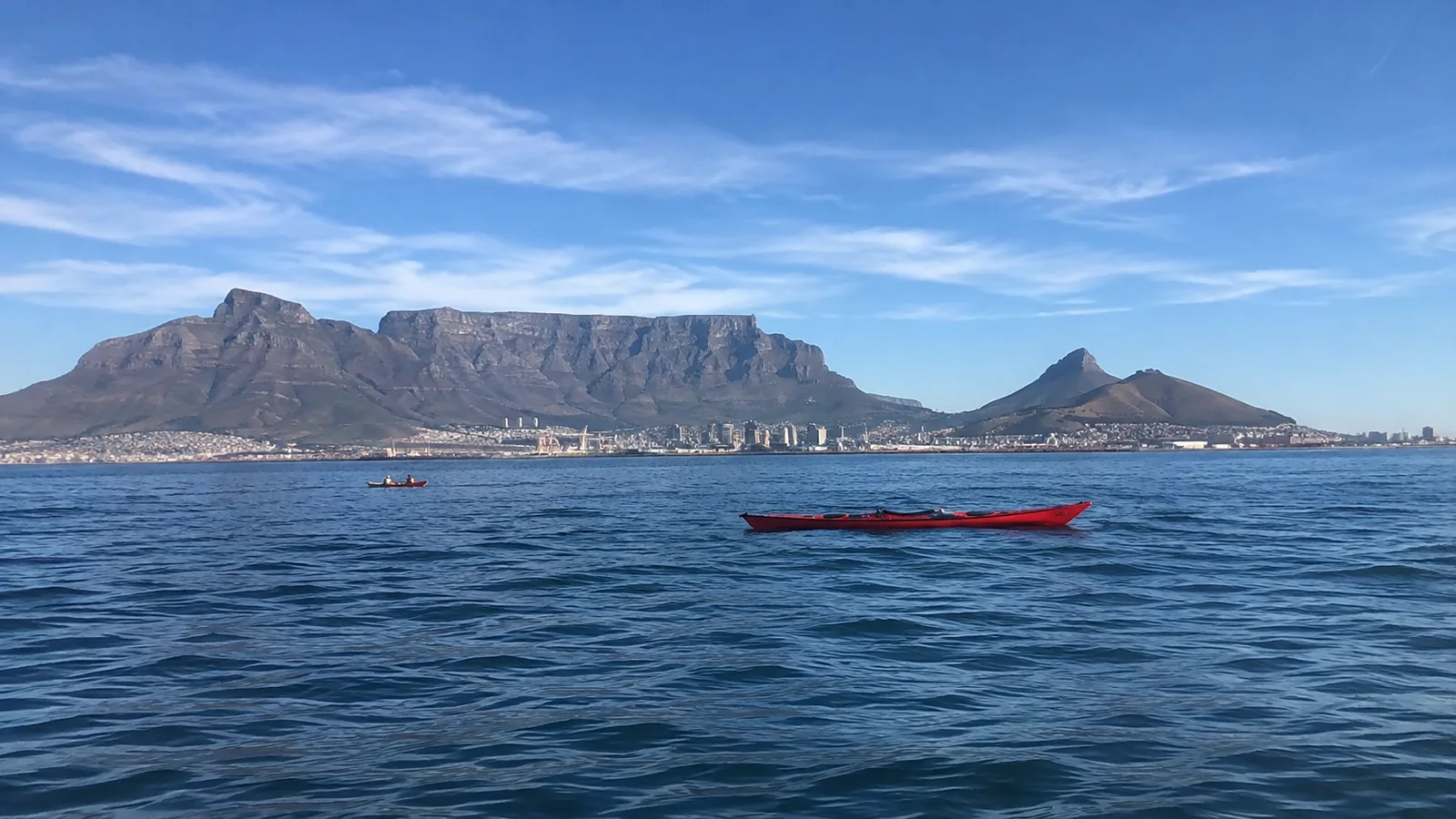
- Choose Sea Point or Granger Bay for the classic city, Lion’s Head, and Table Mountain skyline.
- Choose the V&A Waterfront canals for a gentle first paddle or a weather backup.
- Choose a guided skills session instead of a sightseeing tour if your goal is independent sea kayaking.
If wildlife is your only reason for booking, adjust that expectation now. A reputable operator can choose a sensible route and help you spot animals, but it cannot schedule a dolphin, whale, seal, or penguin appearance.
1. Simon’s Town kayaking for penguin habitat
Simon’s Town sits on the False Bay side of the Cape Peninsula and offers the most recognizable wildlife-focused route. Guided trips commonly launch from Long Beach or Seaforth and paddle toward the rocky shoreline around Boulders and Windmill Beach, with the exact route controlled by conditions.
The Boulders Penguin Colony is a protected home for endangered African penguins, not an aquatic petting zoo. Kayakers should follow the guide’s line, avoid landing in restricted areas, keep noise down, and allow wildlife to choose the distance.
A kayak tour does not normally replace the land visit through SANParks. The boardwalk gives a more predictable look at the colony, while the water trip offers coast scenery and only a possibility of penguins swimming nearby.
Best for: Wildlife-curious beginners who are comfortable on open water and can paddle for roughly two hours.
Think twice if: You expect guaranteed close-up photographs, cannot climb into a kayak, or will feel cheated if the guide keeps a respectful distance.
2. Hout Bay kayaking for cliffs and seals
Hout Bay combines a busy fishing harbor with views toward Chapman’s Peak and the Karbonkelberg coastline. Some tours explore near the harbor and seal areas, while longer or more advanced outings may trace more exposed water outside it.
The scenery can be enormous, but so can the difference between a protected inner route and an open-coast paddle. Ask exactly where a beginner tour normally turns around, whether it exits the harbor, and what wind or swell sends it to a backup route.
Seals may surface near kayaks, yet following, feeding, touching, or boxing them against rocks is not responsible wildlife watching. Keep your hands in the boat and let the guide manage space around resting animals, fishing vessels, and harbor traffic.
Best for: Travelers who prioritize cliffs and an active harbor atmosphere over penguins.
Think twice if: You dislike boat traffic, smell sensitivity makes a working harbor unpleasant, or you need water that feels lake-calm.
3. Sea Point and Granger Bay for the Cape Town skyline
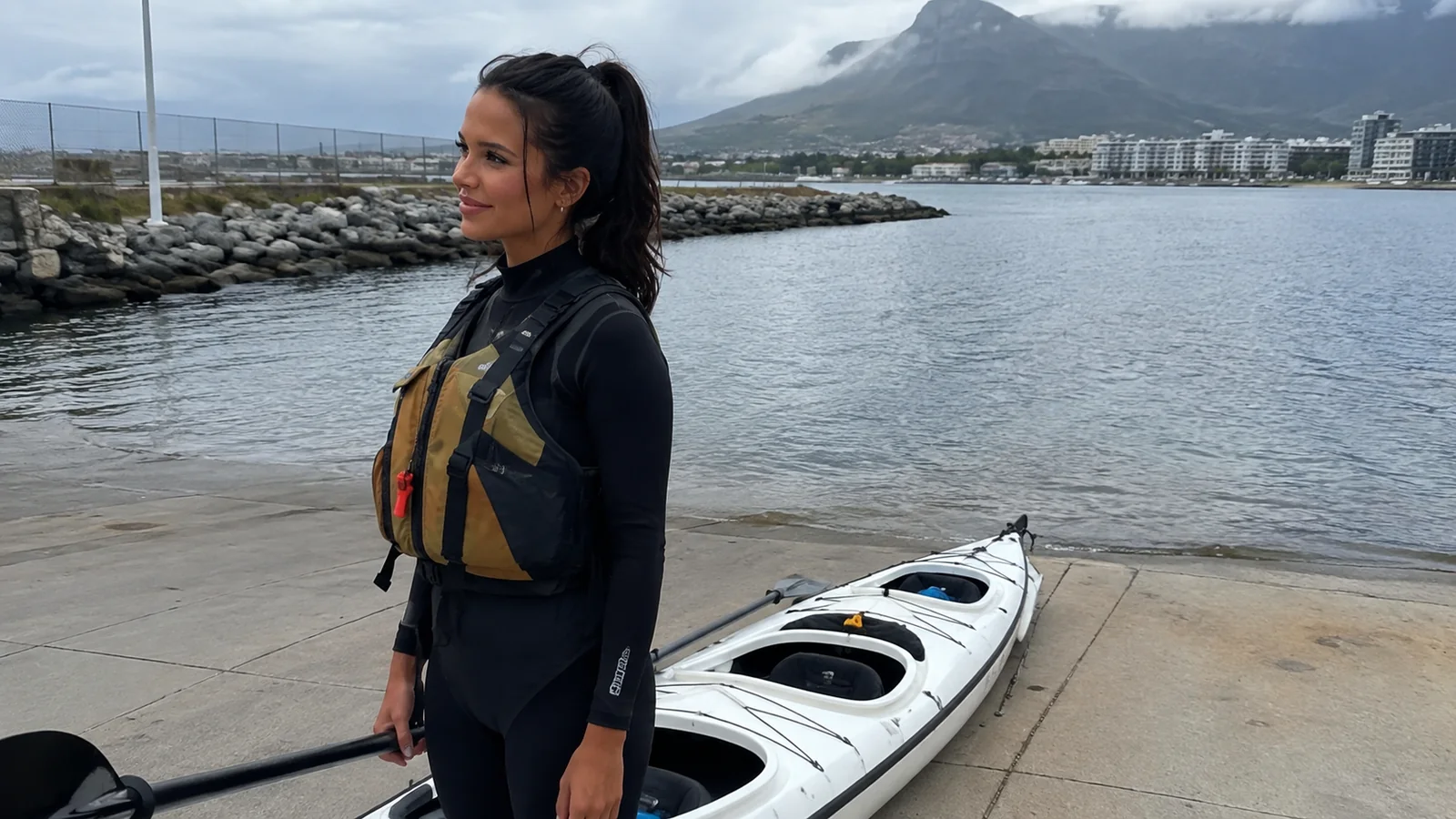
A Sea Point or Granger Bay paddle turns the camera back toward the city, with Signal Hill, Lion’s Head, and Table Mountain framing the shore. This is the most convenient ocean choice for travelers staying near the V&A Waterfront, Green Point, or the Atlantic Seaboard.
The Atlantic side can be cold and exposed even under a bright blue sky. A forecast that looks lovely for lunch may still contain wind direction, swell period, or wave height that makes kayaking inappropriate.
Current operators advertise roughly two-hour small-group outings from protected launch points, but routes remain weather-dependent. Confirm whether the trip is in a stable sit-on-top tandem, which clothing is supplied, and whether showers or secure storage are available afterward.
Best for: Short itineraries, mountain views, and couples or friends who want ocean time close to central Cape Town.
Think twice if: Your main goal is penguins or you assume proximity to the city makes the sea predictable.
4. V&A Waterfront canal kayaking for an easier introduction
Canal paddling around Battery Park and the V&A Waterfront is not a substitute for a sea-kayaking route. It is a useful alternative for nervous beginners, families who meet the operator’s age rules, or travelers whose ocean session has been canceled.
Daylight tours focus on a simple urban paddle, while current operators also advertise evening sessions under city lights. The water is more sheltered, but you still need a fitted personal flotation device, a safety briefing, and an honest answer about water quality after heavy rain.
Best for: A first paddle, limited time, or an urban activity that does not depend on seeing wildlife.
Think twice if: You booked Cape Town specifically to feel the ocean swell or photograph the mountain from offshore.
When is the best time to kayak in Cape Town?
Cape Town kayaking can operate year-round, but no month guarantees suitable water. Summer, roughly November through March, often brings drier weather and strong southeasterly wind, while winter brings cooler, wetter weather and frontal systems from the northwest.
Early morning is often the most useful booking window because local winds can strengthen later, especially in summer. That pattern is not a rule, so a guide should still make the decision from the current route-specific marine forecast.
Check the South African Weather Service marine forecast even when the operator confirms the night before. Wind speed and direction, swell height and period, visibility, thunderstorms, and harbor notices matter more than the sun icon in a general weather app.
Winter is not automatically off-limits, and summer is not automatically calm. I would keep two possible mornings open and avoid building a nonrefundable day around one narrow kayaking slot.
What about whale season?
Southern right and humpback whales may be seen around the Cape during portions of the cooler months, with the broader regional watching season often described as winter into spring. Presence changes by species, year, and location, so kayaking should never be sold as a guaranteed whale encounter.
If a whale appears, follow the guide immediately and do not paddle toward it for a photograph. For travelers planning the broader region around whale possibilities, this South African whale-route overview helps place Cape Town within a longer coastal trip.
How cold is the water?
The Atlantic Seaboard is influenced by cold water and can feel startling even on a hot day, while False Bay is often warmer. Temperature changes with season, wind-driven upwelling, and the exact site, so dress for immersion rather than the air temperature on shore.
Ask whether the operator supplies a wetsuit, paddle jacket, spray top, or only a personal flotation device. Quick-drying layers are better than cotton, and a dry change of clothes belongs in a bag that stays with the operator or in a truly waterproof dry bag.
Do beginners need kayaking certification?
Most short guided sightseeing tours do not require formal certification or previous paddling experience. That does not make every body, weather window, or route suitable for every beginner.
Operators set their own minimum age, maximum weight, health, swimming, and mobility rules. Tell them about shoulder or back limitations, pregnancy, recent surgery, heart or respiratory conditions, and any difficulty getting down to floor level before paying.
If you want to rent a sea kayak and leave without a guide, sightseeing experience is not enough preparation. You need route planning, capsize recovery, assisted rescue, navigation, weather interpretation, cold-water clothing, communication, and local launch knowledge.
How to choose a safe Cape Town kayaking operator
A glossy wildlife gallery tells you almost nothing about risk management. Current listings from Kayak Adventures show weather-dependent guided trips in Simon’s Town, Hout Bay, Sea Point, and the Waterfront, which is useful for comparison rather than an automatic endorsement.
Ask these questions before booking:
- Is the guide trained in sea-kayak rescue and first aid?
- How many guests paddle with each guide?
- Will every guest wear a correctly fitted, certified personal flotation device?
- Does the guide carry a VHF radio, waterproof phone, or personal locator beacon?
- Is there a tow system, first-aid kit, and spare paddle?
- Which forecast source and thresholds determine cancellation?
- What is the capsize plan, and will the safety briefing cover it?
- Are tandem kayaks used for beginners, and who pairs with a solo traveler?
- What happens to the booking if weather prevents departure?
South Africa’s National Sea Rescue Institute says paddlers should wear a certified high-visibility PFD and carry appropriate communication equipment. Its paddling safety advice is written for independent paddlers too, but it gives travelers a sensible standard for judging tour equipment.
A cancellation is evidence that conditions were taken seriously, not proof that your vacation was mishandled. If an operator pressures a nervous guest, skips the fit check, or launches into visibly worsening conditions without a clear explanation, walking away is reasonable.
Sharks and other fears
Sharks live in the waters around Cape Town, as do many other marine animals. The useful question is not whether the ocean contains sharks, but how the operator manages the selected launch, current observations, wildlife behavior, group control, and emergency plan.
Do not let sensational marketing persuade you that kayaking beside a wild predator is a guaranteed attraction. Equally, do not treat every fin or dark patch as an emergency; stay with the group and follow the guide rather than improvising.
What to wear and bring
- Quick-drying shirt, shorts, or leggings
- Secure water shoes that can get wet
- Warm layer or paddle jacket for wind
- Broad-spectrum sunscreen and lip protection
- Hat with a secure strap
- Sunglasses with a retainer
- Reusable water bottle
- Towel and complete dry change of clothes
- Waterproof pouch for essential medication
Leave jewelry, loose hats, and anything you cannot afford to soak on land. A phone case with a neck cord can become an entanglement, so ask the guide where it should be secured rather than hanging it loosely.
For the rest of your trip kit, these practical travel-planning tips cover insurance, money backups, and documents that matter beyond the water.
Photography without losing the paddle
A waterproof action camera with a short, secure attachment is easier than handling an unlocked phone over cold water. Agree with your paddling partner before launch about who will stop paddling and when, because two people reaching for cameras at once leaves no one controlling the kayak.
Never crowd wildlife, rocks, another kayak, or a harbor channel for a photograph. The best image is not worth separating from the guide or drifting into a place that requires a rescue.
Plan the rest of the day around the route
Pair Simon’s Town kayaking with the official Boulders boardwalk or Cape Point, not a rushed cross-city reservation. Table Mountain National Park extends along much of the peninsula, and this roundup of the world’s beautiful national parks gives the Cape landscape useful context.
Pair Hout Bay with a meal near the harbor or Chapman’s Peak Drive only if the road and weather are open. Sea Point fits naturally with the promenade and central city, while canal kayaking leaves enough time for the Waterfront’s museums, restaurants, and harbor activities.
Do not put a timed Robben Island boat, international flight, or prepaid Cape Point tour immediately after a weather-dependent paddle. Salt water, traffic, a slow group, or a changed launch can stretch the morning.
My Cape Town kayaking recommendation
Choose Simon’s Town if respectful penguin viewing is the dream, Hout Bay for the grandest cliff-and-harbor scenery, and Sea Point for the most efficient city-based ocean outing. Choose the canals when confidence or conditions make sheltered water the happier decision.
Whichever route wins, book a guided trip with clear safety answers, keep a backup window, and let the marine forecast overrule the itinerary. Cape Town’s coastline is memorable because it is alive and changeable, which is exactly why a responsible plan stays flexible.