What to Do If You Miss the Cruise Ship
If you miss your cruise ship, take a breath and don’t buy a flight yet. Call the port agent and cruise line first, confirm where the ship is going next and whether you can rejoin, and expect to pay the catch-up costs yourself unless insurance covers them.
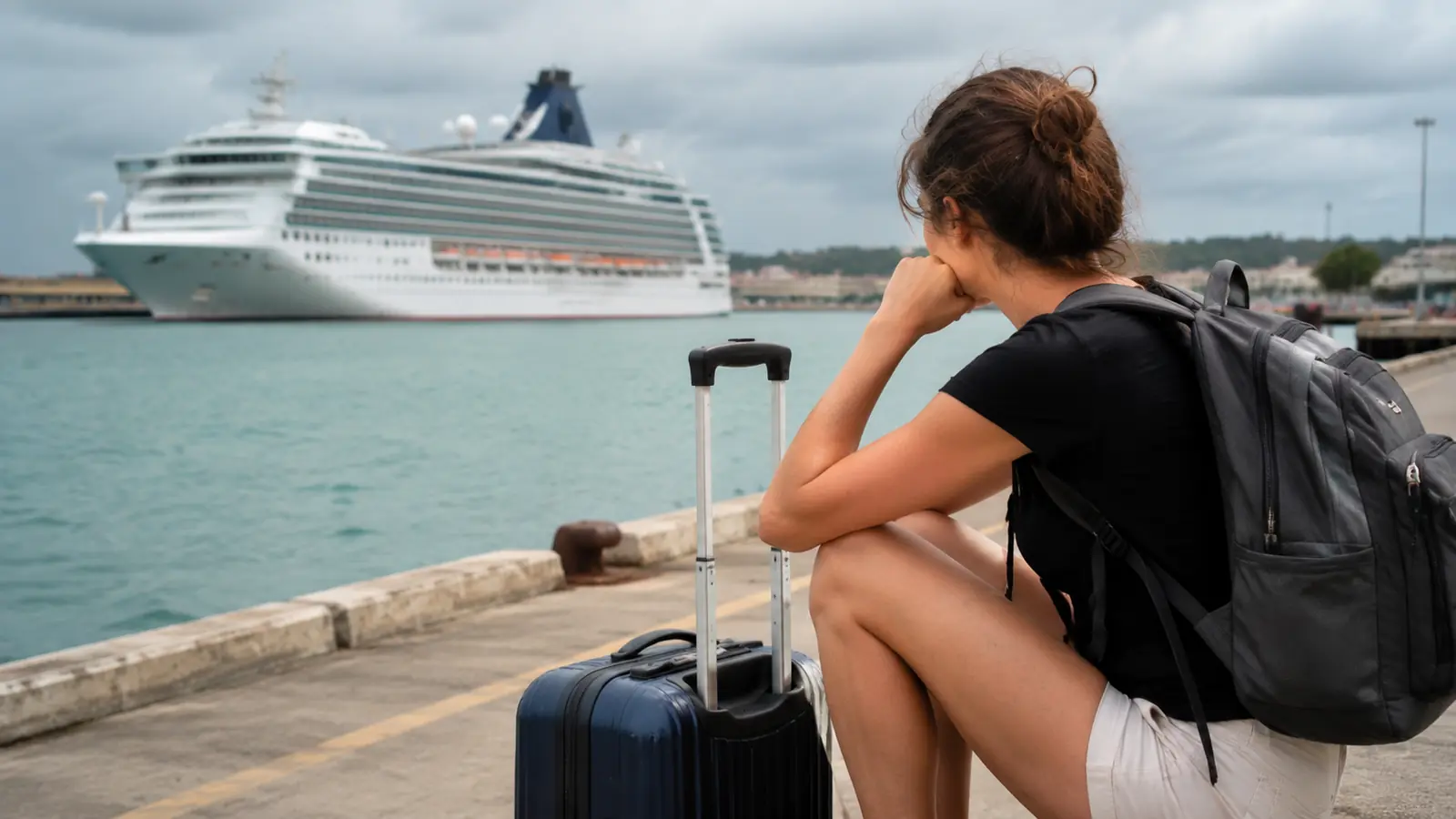
First, figure out which kind of missed ship this is
Missing embarkation day and getting left behind in a port are two very different problems. On embarkation day you still have your bags and passport, you just don’t have a ship yet.
Get left behind mid-cruise, though, and your cabin, luggage, meds, and maybe your passport are sailing off without you. That’s the scarier version, and most of this guide is about keeping it manageable.
A medical disembarkation is its own thing. If you or someone in your group is in a hospital, work with the hospital, the cruise line, your insurer’s assistance line, and your embassy instead of following a catch-up plan.
What to do in the first 10 minutes
- Get to a safe, public spot near port security or a staffed terminal.
- Call the port agent listed in the ship’s daily program, app, or port info sheet.
- Call your cruise line’s emergency or day-of-travel line (it’s in your booking documents).
- Give your full name, ship, booking number, cabin, where you are, your phone number, and who’s with you.
- Ask where the ship is going next and whether you’re allowed to rejoin there.
- Tell them if your passport, medication, money, or luggage is still onboard.
- Snap photos of the terminal, gate notices, the local time, and whatever delayed you (traffic, a canceled ferry, a broken-down bus).
Don’t sprint into restricted areas, argue with security, or hire a private boat to chase the ship. Once the gangway is up and the ship is moving, it’s the captain’s and the port authorities’ call.
Use the emergency number in your own booking records, not one you found in an old Facebook group. Royal Caribbean, for example, sends guests who miss departure because of travel delays to its Emergency Travel Team to talk through their options.
Find the port agent (they’re your best friend right now)
The port agent is the local company that handles the ship’s business ashore, and they’re your best bridge to port officials and the ship itself. Their name and number are usually in the daily program, the cruise line app, or on a port info card at the gangway.
Can’t find the number? Show port security your cruise card and ask them to reach the ship’s agent, then call the cruise line and your travel advisor if you have one.
Here’s my habit: screenshot the port agent info and the all-aboard time before you walk off the ship. Cruise apps can need the ship’s Wi-Fi or log you out at the worst moment, and a screenshot works with zero signal.
What Royal Caribbean, Carnival, and Norwegian actually say
Every big line’s rules boil down to the same thing: the ship won’t wait for guests exploring on their own, and getting back to it is on your dime. Here’s how the three biggest lines spell it out.
Royal Caribbean
Royal Caribbean says joining at the next port is possible in specific situations if you have the proper documents, but you have to work it out with the Emergency Travel Team first. You pay the costs of meeting the ship, unless you bought Royal Caribbean’s Travel Protection and a carrier delay caused the miss, in which case it can reimburse catch-up travel, hotels, and meals.
On embarkation day, you need to be checked in and onboard at least 90 minutes before port operations close, or you won’t sail. If a Royal Caribbean shore excursion runs late, the line guarantees the ship will wait, and if it truly can’t, it gets you to the ship at no cost.
Carnival
Carnival’s ticket contract is blunt: no refunds for no-shows, and any cost to rejoin the ship (airfare, hotels, visas, government fees, launch fares, agency fees) is yours. Carnival has also said the ship has no obligation to delay departure for guests exploring on their own who aren’t back on time.
The exception is Carnival’s Fly2Fun air program. If a flight booked through it makes you miss embarkation, Carnival says it will arrange a way for you to meet the ship (typically at the first port of call) when the law allows, or give you a future cruise credit if there’s no workable option.
Norwegian
Norwegian’s terms say you must be checked in and onboard at least one hour before departure on embarkation day, and back from each port at least one hour before the ship’s scheduled departure. Your daily schedule lists the exact all-aboard time, so treat that as the real deadline.
Miss embarkation and Norwegian may let you join at an approved port later in the itinerary, but the fees and travel costs are yours. Miss the ship in port and you pay whatever it takes to rejoin, and there are no refunds for no-shows.
A real example: in 2024, eight Norwegian Dawn passengers on a private tour missed the all-aboard time in São Tomé. Norwegian left their passports with the local port agent, and the group spent days trying to catch up before rejoining the ship in Senegal.
If your passport is still on the ship
Tell the port agent right away and ask whether ship security pulled it from your cabin safe to hand off ashore. Lines often do this (Norwegian called it its regular protocol in São Tomé), so stay put and reachable while they check.
If your passport can’t be recovered, go to your country’s nearest embassy or consulate. For U.S. citizens, the State Department says a passport reported lost or stolen is no longer valid for international travel, so you’ll need a replacement from a U.S. embassy or consulate abroad.
Plan on an in-person appointment. Bring a 2×2 inch (5×5 cm) passport photo, ID like a driver’s license, proof of citizenship (a photocopy of your missing passport counts), your travel itinerary, and a police report if you filed one.
If you’re short on time, the embassy may issue a limited-validity emergency passport good for up to one year. Check with your airline and any country you’ll pass through that it will be accepted on your route home.
A photo of your passport on your phone helps prove who you are, but it isn’t a travel document. And if you only packed a U.S. passport card, know that it’s not valid for international flights.
Not a U.S. citizen? Contact your own embassy or consulate and check the transit rules for every leg of your route, because advice written for U.S. passport holders won’t match yours.
Get four answers before you book anything
Will the ship actually stop there?
Weather, mechanical problems, strikes, medical emergencies, and port orders can all change an itinerary overnight. Get the next port and arrival time from the cruise line or port agent, not a ship-tracking app.
Will the cruise line let you back on?
A flight to the next port isn’t permission to board. The line has to clear it with security, local officials, and the ship first, so wait for a clear yes.
Can you legally enter that country and get home?
Check passport validity, visas, electronic travel authorizations, transit rules, and proof of onward travel for your nationality. Cruise passengers often get simpler entry arriving by ship than they would flying in, so don’t assume the same rules apply once you’re on your own.
This is where the document rules from my Bahamas cruise passport guide come into play, even if you’re nowhere near Nassau. U.S. citizens on a closed-loop cruise can reenter by sea with a birth certificate and government photo ID, but CBP’s Western Hemisphere Travel Initiative rules only cover the U.S. border, and flying home from another country takes a passport book.
Is joining at that port even allowed?
On foreign-flagged ships sailing from the U.S., a federal law called the Passenger Vessel Services Act limits where guests can get on and off, and the cruise line can be fined when it’s broken. Let the line tell you which port works, and get the instructions in writing before you pay for anything.
If you missed embarkation day
Call the cruise line the moment a delayed flight, train, or traffic jam threatens your arrival, ideally before the ship sails. Don’t wait until you’re at baggage claim, and don’t assume the airline will tell the cruise line.
Ask whether you’ll be marked as a no-show, whether you can join later, and what happens to prepaid packages, excursions, and your return transfer. Carnival and Norwegian both say no refunds for no-shows, so get any promise of a credit in writing.
If you booked flights through the cruise line, call that air desk as well as the airline, since programs like Carnival’s Fly2Fun can help you catch up. They still can’t fix a missing visa or a port that won’t let you board.
The best prevention is boring, but it works: fly into your embarkation city at least a day early, and two days early in winter or when you’re flying in from overseas. My 90-day cruise planner keeps your hotel, transfers, documents, and emergency numbers in one place.
If the ship left you in a port of call
First, confirm who in your group is actually ashore. Give the port agent everyone’s names and cabin numbers, and if a travel buddy made it back onboard, have them tell Guest Services (and stay on the ship).
Ask specifically about your passport, daily medication, mobility equipment, and luggage. Depending on timing, the line might hand items off through the port agent or keep them onboard until you rejoin.
If you can’t travel the same day, book a real hotel and use official taxi stands or transportation arranged through the agent or a reputable company. Skip the stranger with a boat who shows up the moment he hears you missed the ship.
If a crime, theft, or injury was part of what happened, file a police report and keep the report number. U.S. citizens who can’t reach the local embassy can call the State Department’s emergency line at 888-407-4747 from the U.S. or Canada, or +1 202-501-4444 from anywhere else.
Not American? Your own government has a similar consular hotline, so save that number before you sail.
Will travel insurance cover missing the ship?
It might, depending on why you missed it. Call the assistance number on your policy before you spend big, explain what happened, and ask what approval and paperwork they need.
Missed connection, trip interruption, travel delay, and medical evacuation are separate benefits with their own definitions, waiting periods, and dollar limits. A covered flight delay or medical emergency is a very different claim from losing track of time at a beach bar, which policies generally won’t pay for.
The State Department’s travel insurance guide suggests checking that a policy covers the countries you’re visiting, your trip length, emergency medical care, and medical transportation home. It also points out that Medicare and Medicaid don’t pay for medical care outside the U.S.
Save everything: airline delay letters, taxi and hotel receipts, meal receipts, medical records, police reports, screenshots, and a simple timeline of your calls. Photograph paper receipts right away, and write down your claim number and every rep’s name.
If you can’t reach the insurer and your safety is at stake, make reasonable arrangements and note why. Never put off urgent medical care while you wait on a claims decision.
Will the ship wait if a cruise line excursion runs late?
This is the biggest perk of booking tours through the cruise line. Royal Caribbean guarantees the ship will wait for its delayed tours, and Carnival has said the same about its own excursions, while guests exploring independently are on their own.
If your ship tour is running late, stay with the guide and let them coordinate with the ship. Don’t split off and grab your own taxi, because that takes you out of the cruise line’s safety net.
Some independent tour companies offer a “return to ship guarantee,” which typically covers a hotel night and transportation to the next port if their tour makes you miss the ship. It won’t make the ship wait, so read the fine print before you count on it.
How to avoid missing the ship in port
- Go by ship time, which can differ from the local time your phone switches to.
- Screenshot the all-aboard time and port agent info before you leave the ship.
- Set two alarms, and treat the first one as your real deadline.
- Carry the ID the ship and port require, plus a copy stored separately.
- Download an offline map and pin the right pier or tender dock.
- Head back earlier when a tender, ferry, cable car, border crossing, or mountain road is involved.
- Use licensed transportation and agree on the pickup plan before you go.
- Bring a credit card and some cash for a backup taxi or a change of plans.
All aboard is usually 30 to 60 minutes before the ship’s listed departure time, so that’s your deadline, not sail-away. On an easy, walkable port day, I’d aim to be back near the pier 60 to 90 minutes before all aboard.
Give yourself way more cushion for far-off tours, tender ports, island ferries, or anything that depends on a single road. Carnival has even reminded guests that Caribbean ports don’t always match ship time, so a phone that auto-updates can quietly make you an hour late.
On my 30-day Panama Canal repositioning cruise, Salaverry, Peru was a good example of a port where the buffer matters. The city of Trujillo is about 10 miles (17 km) and a 30-minute drive from the port, so one traffic jam can eat your cushion fast.
My Naples cruise port guide does the same port-day math for Pompeii, Capri, and the Amalfi Coast. It’s a good reminder that no view is worth betting on the last possible train or ferry.
Pack a tiny missed-ship kit
Take your cruise card, required ID, one credit card kept separate from your wallet, a little local cash, any must-have meds, the port agent number, your insurance info, and a charged phone. Toss in a small battery pack and cable, but keep it light enough that you’ll actually bring it ashore.
The State Department’s cruise ship travel tips strongly recommend traveling with a passport book, even when your cruise doesn’t require one, in case you need to fly home in an emergency. They also suggest carrying a copy of your passport separately, packing extra prescription meds in case of delays, and having a backup plan for getting home.

If your travel buddy doesn’t make it back
Tell Guest Services or ship security right away with their name, cabin, phone number, last known location, what they’re wearing, any medical needs, and where they were headed. Don’t get off the ship to look for them unless the crew asks you to, because then the ship has two missing guests instead of one.
Keep calling and texting them, but don’t post passport details or cabin numbers on social media. Let the ship and port teams handle the search and official notifications.
Here’s the order I’d follow
Call the port agent and cruise line, sort out your documents and medication, confirm you can legally travel, and only then book transportation. It feels slower than hitting “buy” on the first flight you see, but it keeps you from paying for a ticket to a port where you can’t board.
Missing the ship is stressful and usually expensive, but it’s a problem you can fix one call at a time. Stay calm, keep every receipt, and you’ll be back onboard (or headed home) sooner than you think.