Cruise Disembarkation Day: A Calm, Clock-Smart Exit Plan
Cruise disembarkation day looks simple until six different clocks start competing. Your ship must be cleared, your departure group must be called, your luggage must be found, border formalities must be completed, and the road to the airport still has opinions of its own.

What actually happens on cruise disembarkation day?
Disembarkation is the controlled process of getting everyone off the ship after its final arrival. A scheduled 7 a.m. arrival means the vessel is expected alongside around then, not that every guest will be standing at the taxi curb at 7:05.
Port authorities and immigration officials may need to clear the ship before anyone leaves. The cruise line then calls guests in groups, usually according to luggage tags, transfer arrangements, loyalty or suite privileges, accessibility needs, and onward travel.
Royal Caribbean’s current departure guidance, for example, tells guests to follow the color and time on their luggage tag and reach the assigned lounge 15 minutes early. Treat your own ship’s app, printed departure letter, announcements, and crew directions as the final word because procedures vary by voyage.
Do the important work the night before
Start with your onboard account while Guest Services is still manageable. Match unfamiliar charges to receipts, confirm any refundable credit, download or photograph the final statement, and resolve a problem before leaving the ship.
Next, check your departure assignment and the deadline for putting tagged bags outside the cabin. If the time conflicts with a cruise-line transfer, accessibility arrangement, or flight, ask Guest Services instead of quietly joining a different group.
Your cruise planning system should include one final-night checklist, because tired brains are excellent at packing tomorrow’s shoes. Put these items in the bag that stays with you:
- Passports, citizenship documents, driver’s licenses, cruise cards, and customs information
- Prescription medicine, hearing aids, glasses, mobility supplies, and essential medical equipment
- Phone, chargers, laptop, camera, jewelry, cash, cards, and house or car keys
- Airline confirmations, transfer details, hotel address, and the port-agent contact
- One complete outfit, underwear, weather layer, and travel-size toiletries
- Anything a child needs before you can reach the checked luggage again
Do not pack the shoes or clothing you need to leave the ship. Keep any item that would be expensive, dangerous, or impossible to replace out of the hallway luggage.
Choose self-assist or checked-luggage departure
Self-assist walk-off
Self-assist means every suitcase stays in your cabin overnight and you personally carry it off. Royal Caribbean’s official comparison of self-assist and regular departure makes clear that guests still pass through immigration and customs after the gangway.
This can be useful for a light packer who wants an early exit and can control every bag without help. It is a poor bargain if you cannot safely manage luggage through elevators, ramps, gangways, thresholds, lines, and a busy terminal.
An early self-assist group is not permission to block the stairs before clearance or to push around guests with mobility needs. It also cannot fix a late arrival, delayed clearance, broken gangway, long immigration line, or freeway crash.
Regular checked-luggage departure
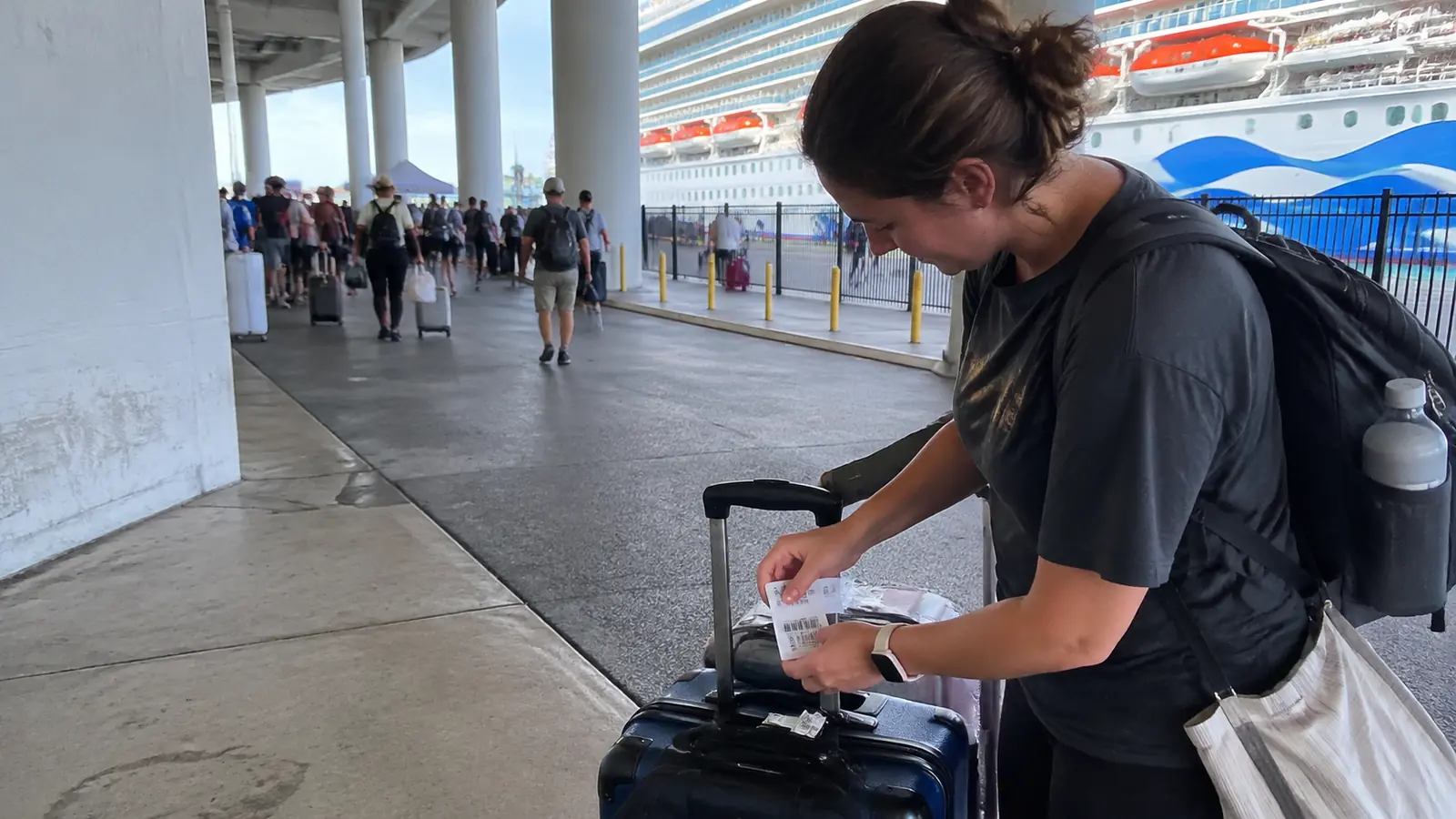
With regular departure, you attach the supplied tags and place most bags outside the cabin by the stated deadline. Crew move them ashore, and you collect them in the terminal zone matching your tag after your group is released.
This is usually kinder to families, larger packers, and travelers who cannot lift or roll everything independently. Build in time to locate a similar-looking suitcase, check its name tag, and use a porter if that suits your needs.
Bright straps or a distinctive luggage cover help, but never put medicine or identity documents in a bag you surrender. Review the practical dimensions and handling questions in this cruise luggage size explainer before deciding that three large cases will be easy to walk off.
Your final morning, in the right order
Wake early enough to eat, check drawers and the safe, charge devices, and leave the cabin by the published time. Breakfast venues and hours are usually reduced, so use the final-day schedule rather than assuming yesterday’s room service or dining hours still apply.
Scan the bathroom shelves, bedside outlets, closet safe, under the bed, and balcony. Return borrowed items and make sure every member of the party has their own documents before the cabin door closes behind you.
Wait in the assigned lounge or permitted public space, not in a stairwell beside the gangway. When your number or color is called, scan off the ship, follow terminal signs, collect checked bags, and continue to the correct immigration or customs channel.
Immigration and customs are separate from the ship
The exact inspection depends on the country, port, citizenship, itinerary, documents, and local technology. CBP lists facial comparison at participating U.S. seaports, but that technology does not erase the legal requirement to carry the documents specified for your trip.
Never assume a closed-loop U.S. cruise means you can leave identification onboard. The itinerary rules discussed in this Bahamas cruise passport breakdown are a useful example of why destination entry, cruise-line boarding, and U.S. reentry must be checked separately.
Declare purchases, alcohol, currency, food, plants, and animal products when the form or officer requires it. The USDA says travelers entering the United States must declare all agricultural and wildlife products, and fresh fruit handed out by a ship is not automatically exempt.
Do not argue that another passenger walked through with the same souvenir. Officers make the admissibility and duty decisions, so keep receipts and answer plainly.
How early can you safely book a flight?
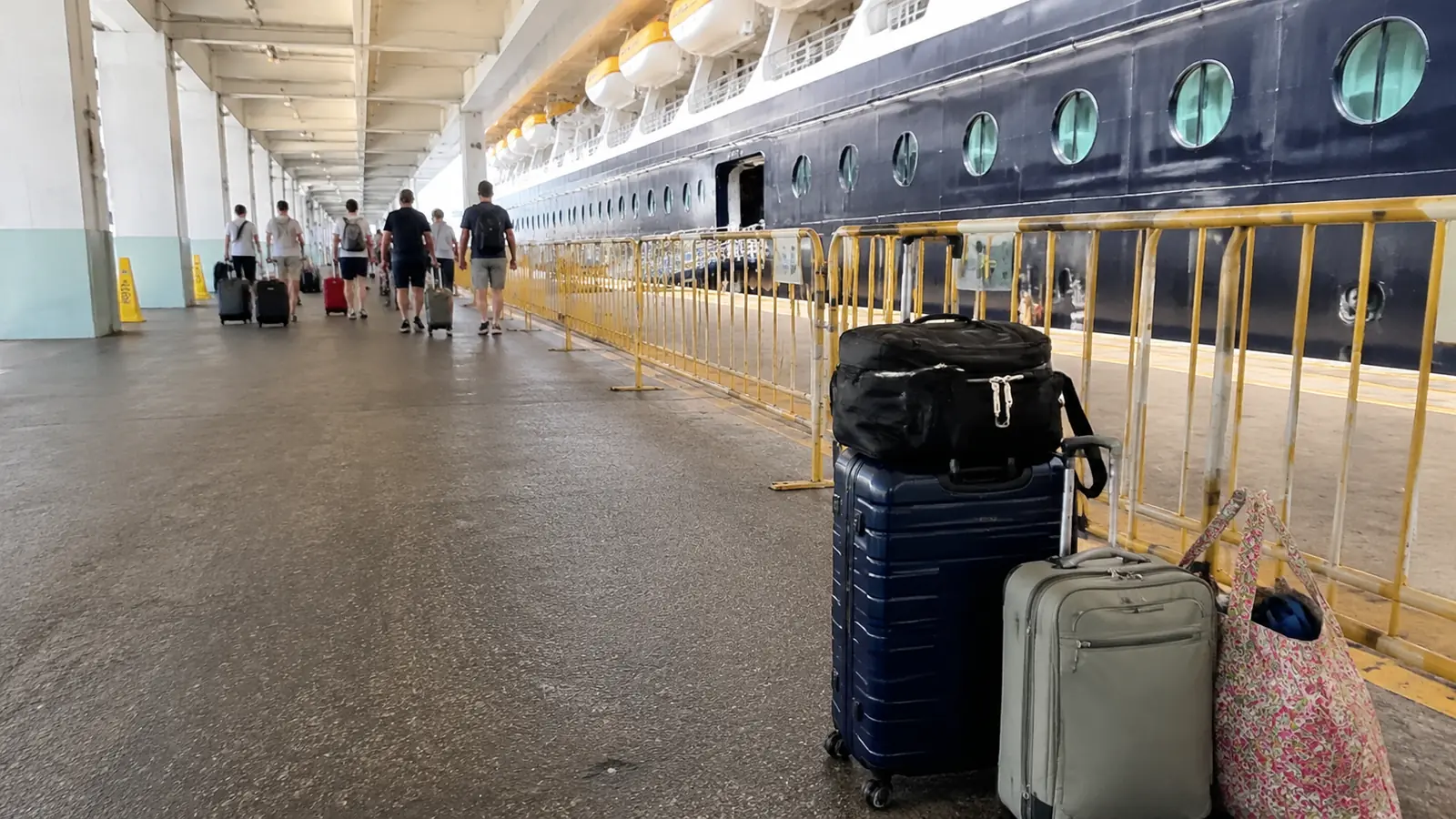
There is no universally safe departure time because a ship’s arrival, clearance, your group, terminal processing, traffic, airline bag cutoff, and airport security are separate variables. A cruise line’s minimum time for selling an airport transfer is an eligibility threshold, not a promise that an independent flight cannot be missed.
For a typical U.S. home port with a nearby airport, I would look for a domestic flight at least five hours after the ship’s scheduled arrival and generally not before noon. For an international flight, a distant airport, holiday traffic, a very large ship, checked airline bags, or limited mobility, choose six hours or more and favor early afternoon.
Those are conservative planning buffers, not guarantees. If missing the flight would unravel an international connection, an important event, or an expensive separate ticket, stay one night after the cruise.
Count backward from the airplane
Your real deadline is not takeoff. Count backward through the airline’s checked-bag cutoff, recommended airport arrival, security, terminal transfer, road travel, port pickup, customs, luggage collection, and ship release; TSA likewise tells travelers to allow time for parking, airline check-in, and security screening.
A noon flight may look four or five hours away on paper, yet the usable margin shrinks quickly when the airport is 45 minutes from the pier. An 8 a.m. flight should never be rescued by a plan that requires being first off a ship scheduled to arrive at 7 a.m.
If you bought airfare or a transfer through the cruise line, read its current conditions and confirm the onboard instructions. Even special luggage services have limits: Royal Caribbean says its participating-port Luggage Valet does not provide airport transportation and guests still complete normal security screening.
Build a ground-transport plan before you dock
Save the terminal name, pickup zone, reservation number, driver’s contact, and realistic travel time offline. A port complex can span multiple terminals, and entering only the city name in a rideshare app can place the car behind a security gate or at yesterday’s berth.
Prebooked cars are convenient only if the provider explains its waiting policy when clearance changes. Taxis may have a dedicated queue, rideshare may require a numbered zone, and cruise-line coaches often wait to fill before leaving.
Rental-car shuttles, trains, and hotel transfers add their own schedules. If your route resembles one of the busy gateways in this East Coast cruise-port comparison, add time for simultaneous ship calls and event traffic.

Disembarkation plans for real traveler scenarios
If you have mobility or sensory needs
Request assistance through the cruise line before sailing and reconfirm the final-day meeting place onboard. Accessible elevators become crowded, terminal distances can be long, and assistance may be staged by group rather than available on demand.
Use checked-luggage departure unless you can manage every bag without compromising safe use of a cane, walker, wheelchair, or service animal. Arrange an accessible vehicle with generous waiting time rather than assuming the taxi queue has one ready.
If you are traveling with children
Keep breakfast simple and make one adult responsible for documents while another tracks people and carry-ons. Put a change of clothes, snacks allowed through the relevant border process, comfort items, and essential medicine in the day bag.
Young children and rolling suitcases are an awkward self-assist combination. The regular luggage service is often worth a later group if it leaves each adult with a free hand.
If you are staying in the city
A hotel stay removes the airport race, but the room may not be ready early in the morning. Confirm luggage storage in advance, keep valuables with you, and plan an easy breakfast, museum, or neighborhood walk rather than dragging cases around town.
If you are cruising back to back
Consecutive guests receive sailing-specific instructions, which can include a group meeting, immigration formalities, a temporary walk ashore, or a brief wait for the ship’s passenger count to reach zero. Follow those directions even if the same cabin, ship, and terminal make the day feel like a non-event.
Do not pack the whole cabin unless instructed, but do keep documents and required medication with you. The logistics and booking questions in this back-to-back cruise planner help separate one long vacation from two legal sailings.
A sample conservative departure-day clock
Imagine a ship scheduled to arrive at 7 a.m. and a domestic flight at 1 p.m. You might eat at 6:30, leave the cabin at 8, hear your group around 8:30, finish terminal formalities by 9:30, reach an airport 45 minutes away near 10:30, and retain a useful cushion.
That timeline is an example, not a prediction. A delayed ship or inspection can consume the entire cushion, which is why the same plan is much less comfortable with a 10 a.m. flight.
Common disembarkation mistakes
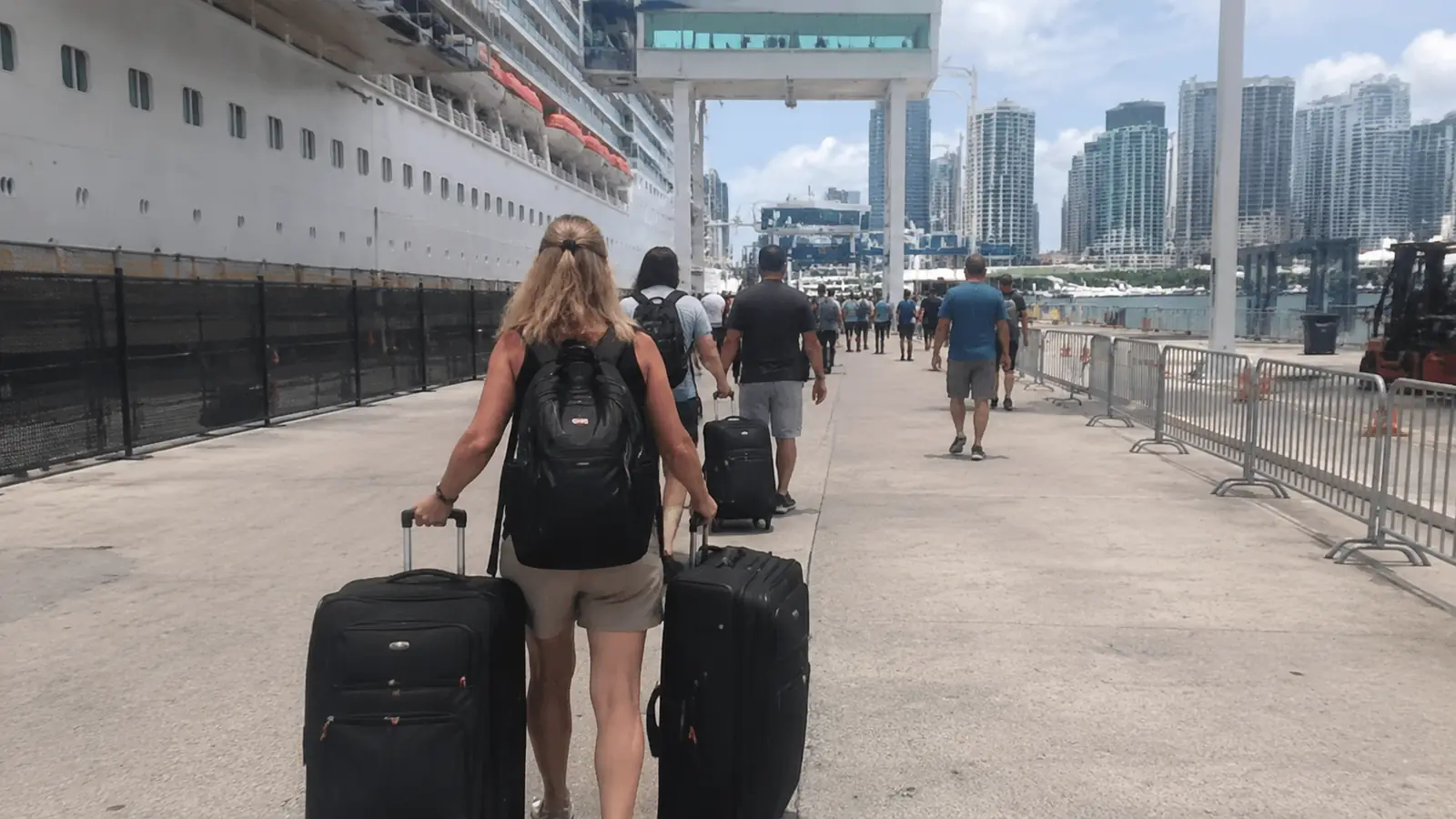
- Putting a passport, medication, car key, or flight outfit in hallway luggage
- Treating scheduled arrival as the moment the gangway opens
- Joining self-assist with more luggage than you can safely control
- Booking a flight around a best-case rideshare estimate
- Taking fresh fruit or other undeclared food through a border checkpoint
- Waiting beside the gangway before your group is called
- Leaving the safe, outlets, and bathroom unchecked
- Assuming onboard gratuities include terminal porters
My best disembarkation-day recommendation
Choose regular tagged luggage when comfort matters more than being first, and self-assist only when every traveler can genuinely manage every bag. Keep the first post-cruise commitment flexible, and buy a flight that survives an ordinary delay rather than one that works only if everything is perfect.
The calmest final morning begins the night before: settle the bill, protect the documents, choose the right luggage method, confirm the pickup point, and preserve a real airport buffer. Then breakfast can still feel like part of the vacation instead of the opening scene of a sprint.