Do Walkie-Talkies Work on Cruise Ships? Rules, Limits, and Alternatives
Walkie-talkies can connect people who are nearby on some cruise ships, but they are not a whole-ship communication guarantee. Before packing them, check the cruise line, the radio service, every country where you may transmit, and whether your group can tolerate missed calls and public conversations.
Do Walkie-Talkies Work on Cruise Ships? Rules, Limits, and Alternatives
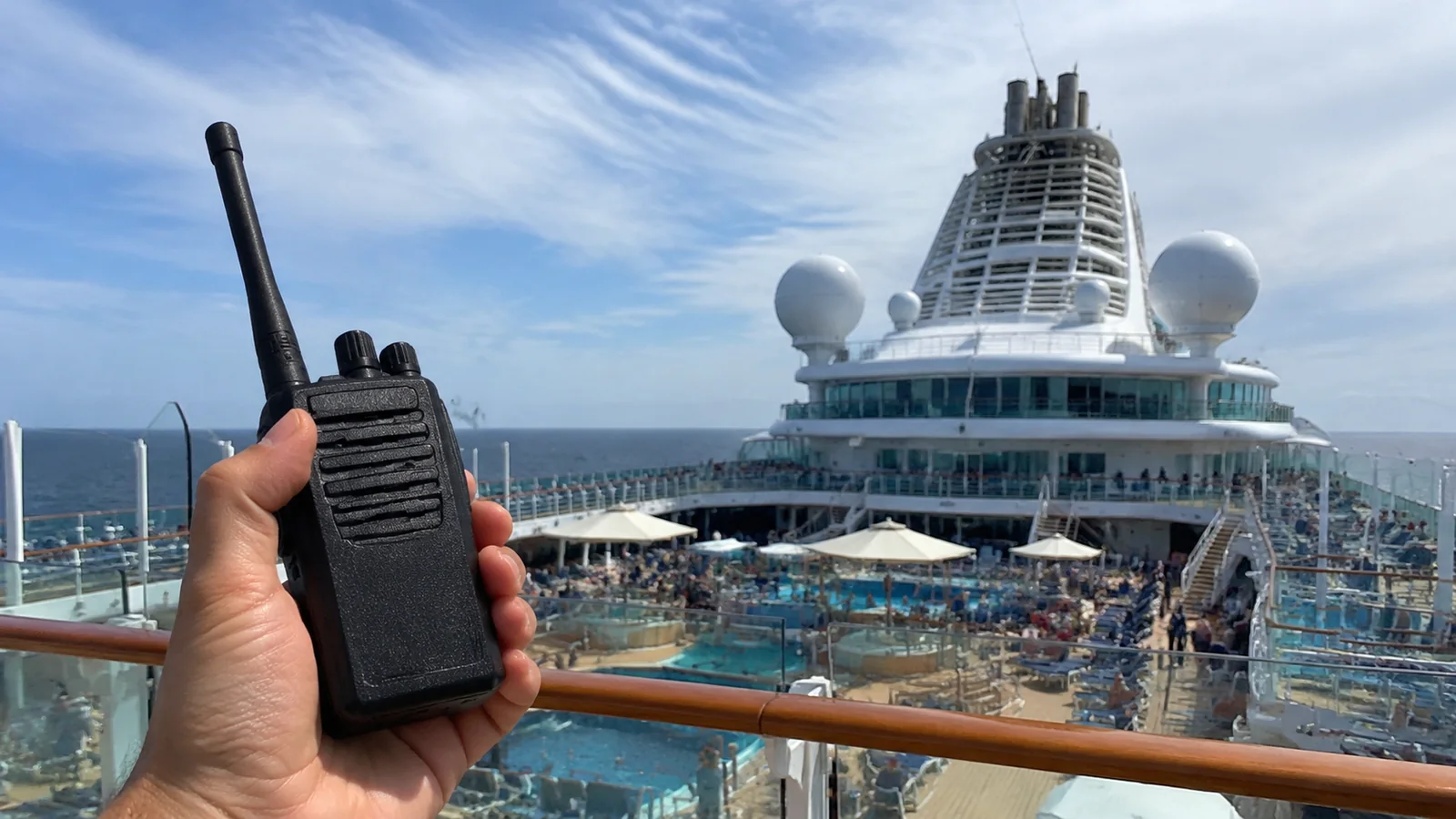
The short answer is sometimes. A permitted pair may work across one open deck or a few nearby interior spaces, then fail between cabins separated by steel decks, elevator cores, machinery, and distance.
The more important answer is that permission and radio law come before performance. Carnival currently prohibits radios, while Royal Caribbean permits narrowly specified two-way radios subject to security review, so no universal packing list can answer for every booking.
Check These Four Things Before You Buy
- Cruise-line policy: Confirm the exact brand’s current prohibited-items wording and save it.
- Radio service: Identify whether the device is FRS, GMRS, amateur, marine VHF, or something else.
- Itinerary law: Verify every country or territory where the transmitter may be switched on.
- Backup plan: Assume calls will fail in some places and agree on meetings, app chat, or notes.
If any answer is unclear, leave the radio off and ask the cruise line or national spectrum regulator. A retailer’s “license-free” label is not permission from a ship or a foreign government.
Carnival Currently Prohibits Radios
Carnival’s current safety information says all speakers and radios are prohibited and will be held for return at the end of the cruise. Its stated reason is that guests and crew need to hear public announcements.
That language makes Carnival an easy decision: do not pack walkie-talkies. An old forum report, prior sailing, or product review does not override the current published rule.
Use the HUB app, paid internet if needed, cabin communication, and fixed meeting points instead. The separate Carnival internet plan comparison helps decide whether Social, Value, or Premium fits the communication tasks on the live offer.
Royal Caribbean Permits a Narrow Category
Royal Caribbean’s current prohibited-items policy permits two-way radios only when they meet stated limits: a maximum advertised range of 10 miles, no more than 5 watts output, internal voice communication only, and no external antenna. The same policy gives ship security discretion to review, retain, or reject questionable equipment.
Royal separately lists amateur radios and baby monitors as prohibited electronic equipment. Do not assume that a radio with a keypad, removable antenna, repeater feature, encryption, data mode, or high-power setting qualifies as a basic permitted walkie-talkie.
Print or save the current policy, but understand that a screenshot does not remove security discretion. Ask Royal before travel when the model sits near a technical boundary.
FRS Versus GMRS in the United States
The Federal Communications Commission regulates personal radio services in the United States. Similar-looking radios can trigger different operating rules based on certification, channel, power, antenna, and features.
FRS is licensed by rule
The FCC’s Family Radio Service guidance says the public may use compliant FRS devices without obtaining an individual license. FRS has 22 shared channels and is intended for short-distance two-way voice communication.
Compliant FRS handhelds use an integral antenna and have limited power, with no exclusive channel ownership. An advertised privacy code does not turn a shared channel into a private conversation.
GMRS requires an FCC license
The FCC’s GMRS guidance describes General Mobile Radio Service as a licensed service around 462 and 467 MHz. A traveler must have the required FCC authorization before using GMRS in the United States.
One individual license can cover eligible immediate family members under current FCC rules, but it does not cover every friend, unrelated cabin mate, tour group, or business use automatically. Check the current eligibility and operator rules rather than treating one license as a group pass.
A combination radio is not automatically license-free
Older packaging and casual listings may call a product “FRS/GMRS.” What matters is how the device is certified and operated now, not which acronym appears largest on the box.
A radio capable of GMRS-only power, repeater input, or removable-antenna operation should not be treated as an FRS radio. Look up the FCC ID and manual, then stay within the authorized service and settings.
Foreign Ports Change the Legal Answer
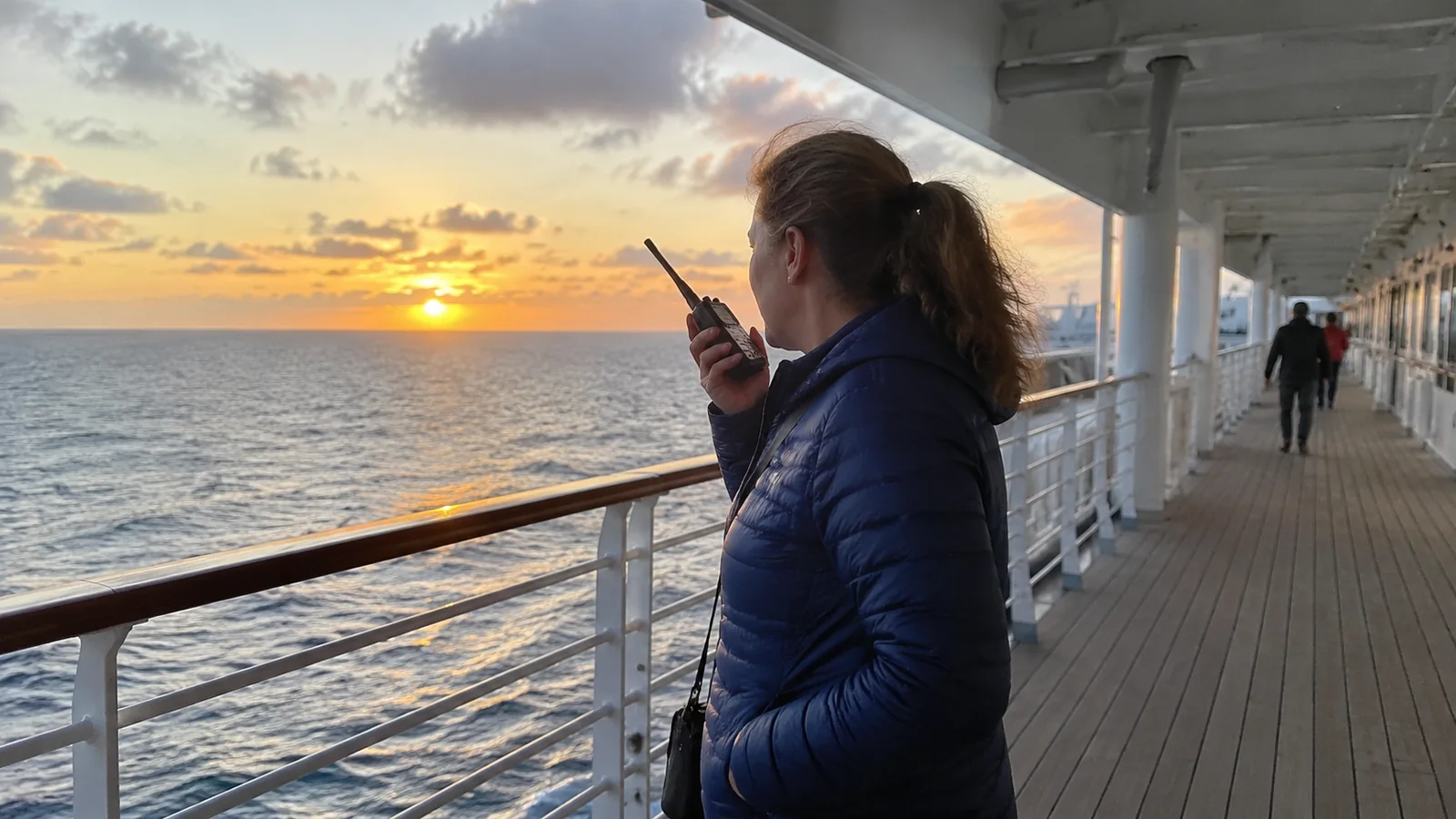
FCC authorization addresses operation in the United States, not automatic use worldwide. Frequencies used for American family radios may have different allocations, power limits, certification requirements, or prohibitions elsewhere.
Canada, for example, permits compliant FRS and GMRS equipment on a license-exempt basis under Canadian standards, but its regulator requires equipment certification and technical compliance. A U.S.-market device is not automatically lawful simply because the channel numbers look familiar.
Mexico, The Bahamas, Caribbean nations, Europe, Asia, and South Pacific ports each require their own check. Do not transmit ashore until the national regulator and the cruise line confirm the device and setting are permitted.
A ship moving among territorial waters makes casual legal assumptions especially risky. This guide is practical planning information, not legal advice, and the safest uncertain radio is one that remains powered off.
Why Advertised Range Collapses on a Ship
Package range claims are usually based on favorable line-of-sight conditions. A cruise ship replaces open terrain with stacked steel decks, bulkheads, fire doors, elevator shafts, plumbing, machinery, cabins, and thousands of people.
Radio waves can be absorbed, blocked, and reflected through that environment. Higher power does not drill a clean tunnel through the ship, and a device that exceeds the line’s limit creates a permission problem before it solves a range problem.
Where a permitted radio has the best chance
- Across the same open pool or sports deck.
- Along a relatively open corridor on one deck.
- Between nearby outdoor areas with fewer major structures.
- During a planned check-in when both people are listening.
Where it is most likely to disappoint
- Between a low interior cabin and the upper pool deck.
- Across many decks or the full bow-to-stern length.
- Inside theaters, elevators, stair towers, or machinery-adjacent areas.
- When one radio is inside a bag, cabin safe, or shielded interior room.
- During crowded periods when other users share the same channel.
Test the pair after boarding without broadcasting private information. One successful lobby call does not establish whole-ship coverage.
Channels, Codes, and Privacy
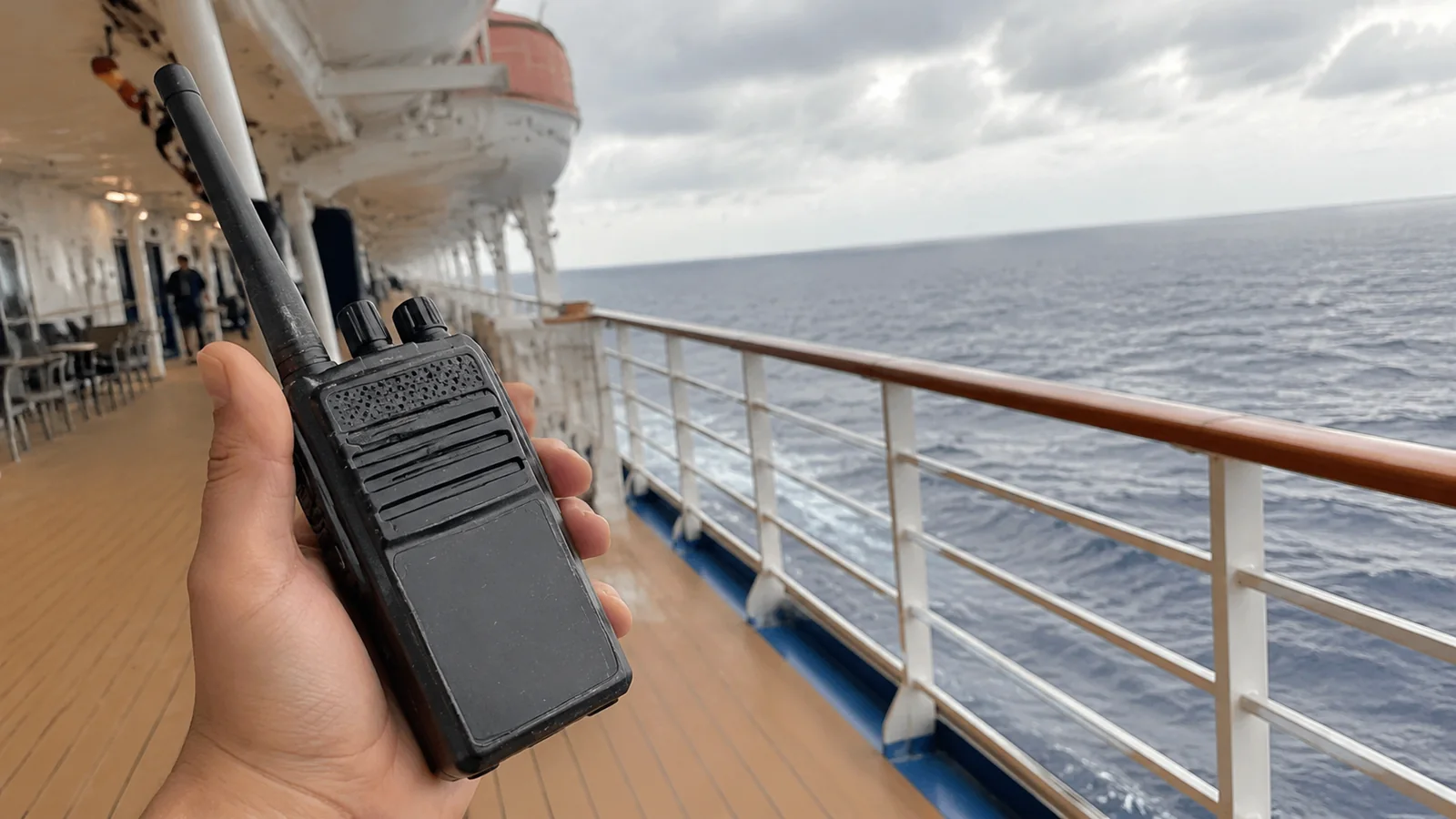
FRS and GMRS channels are shared. Other guests or local users may hear you, interrupt you, or use the same frequency, and you must not claim a channel as your private property.
CTCSS or DCS “privacy codes” generally filter which signals open your speaker. They do not encrypt the transmission or prevent another receiver from hearing it.
Never transmit cabin numbers, full names, medical details, children’s locations, payment information, reservation data, or security-sensitive information. Use a first name or agreed nickname and move sensitive communication to a private method.
Radio Etiquette on a Cruise
Keep the volume low, use an earpiece only if the line permits it, and step away from dining rooms, shows, spa areas, quiet lounges, and ceremonies. A loud chirp or shouted reply is disruptive even when the device is legal.
Press the talk button, pause briefly, speak clearly, and release it. Long stories occupy a shared channel and make coordination harder for everyone.
Set scheduled check-in windows instead of calling repeatedly. If there is no answer, follow the backup meeting plan rather than flooding the channel.
Walkie-Talkies Are Not Emergency Equipment
A consumer radio does not replace the ship’s alarm, public-address system, emergency instructions, muster information, or crew. In an emergency, follow official directions and contact crew through the methods the ship provides.
Do not program marine, aviation, public-safety, crew, or security frequencies into a recreational radio. Being able to receive or enter a frequency does not grant permission to transmit.
A radio also does not prove where a child, older adult, or vulnerable traveler is. Missed calls, dead batteries, a muted speaker, or a blocked signal make it unsuitable as the only supervision plan.
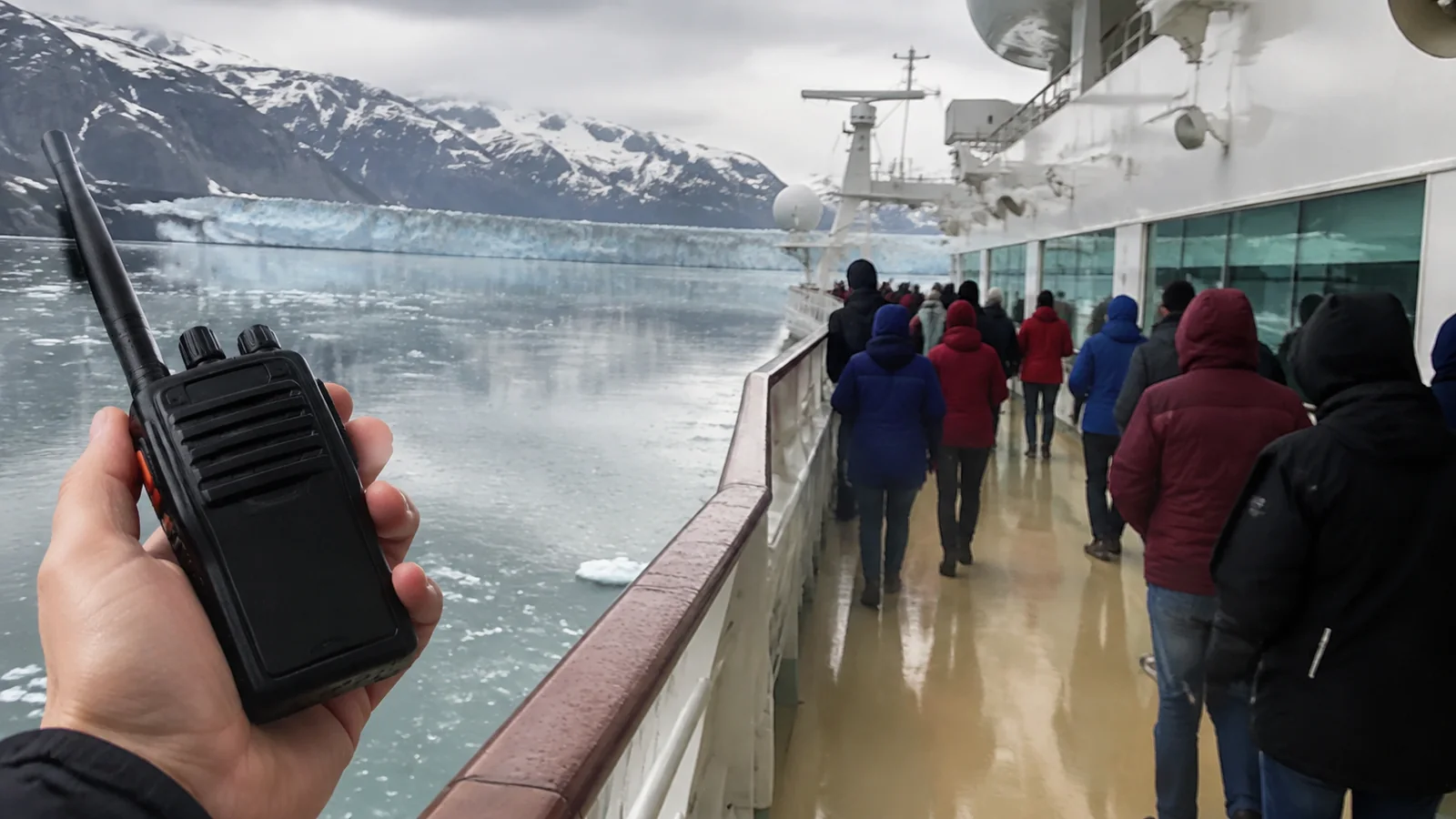
Battery and Charging Planning
Use only the charger and battery type approved for the radio, and inspect batteries for swelling or damage before travel. Follow airline, port, and cruise-line rules for loose lithium batteries and charging equipment.
Charge in the cabin only where permitted and never block ventilation or an exit. Do not leave a radio transmitting accidentally inside luggage.
Bring a written channel and check-in plan in case settings reset. A charged device on the wrong channel is just a small plastic brick.
Better Onboard Alternatives
Cruise-line app chat
Some line apps support guest messaging over the ship’s internal Wi-Fi, with availability and price varying by brand and ship. Royal Caribbean’s current FAQ says its Guest chat is free onboard while connected to ship Wi-Fi.
Download the app, sign in, and update it before travel. Test invitations and notifications on embarkation day because a feature being available does not guarantee every phone is configured correctly.
Paid ship internet
A Wi-Fi plan can support familiar messaging services where the plan and app allow them. Satellite capacity, ship position, congestion, service outages, and device-login limits can still delay messages.
The Royal Caribbean internet guide explains active-device limits and free app access separately. Do not buy internet only because someone confused local app chat with general web access.
Offline meeting system
Agree on a precise place and time, plus what happens after a 10-minute delay. “Meet near the pool after lunch” is not precise on a ship with several pools and several lunch venues.
Use a paper note inside the cabin, cabin voicemail if available, or a permitted whiteboard in an approved location. Do not stick items to doors or walls until the line confirms its decoration and adhesive rules.
The Best Communication Plan for Families
Give each person a simple schedule, ship map, cabin card as appropriate, and two meeting points. Teach children how to identify crew and where to go if they cannot find the group.
Use the youth program’s sign-in, sign-out, and age rules exactly. A walkie-talkie does not override supervision requirements or make independent roaming appropriate.
The first-cruise planning checklist helps anchor communication around embarkation, muster, meals, excursions, and disembarkation. The best system is boring enough that everyone remembers it.
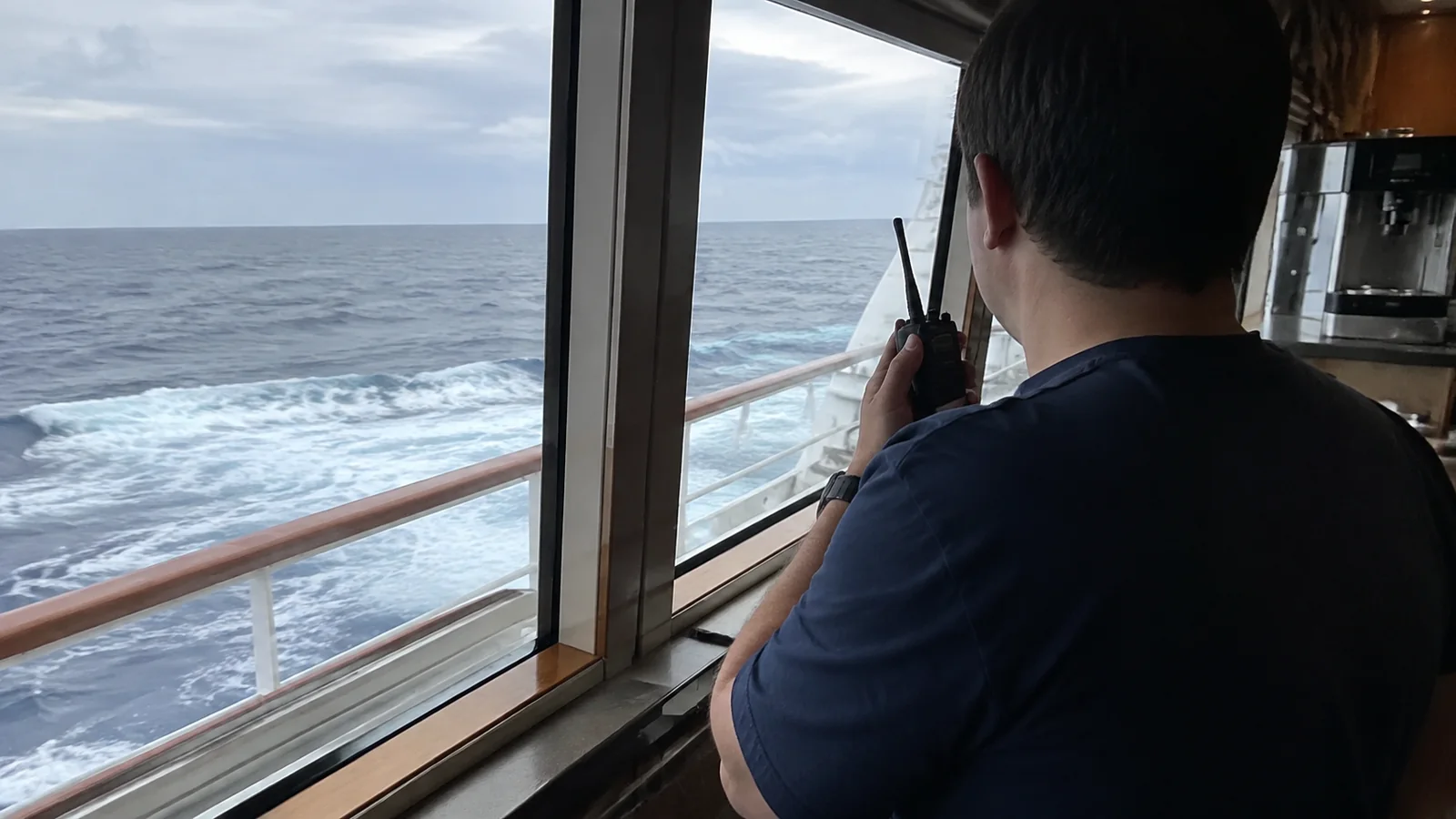
Should You Pack Walkie-Talkies?
Pack them only when the cruise line explicitly permits your model, the radio service is legal everywhere you will use it, and short-range convenience is worth the luggage. FRS is usually the simpler U.S. option than licensed GMRS, but foreign and ship rules still control.
Skip them on Carnival under the current prohibition, on any itinerary with unresolved spectrum questions, or when the group expects reliable whole-ship contact. App chat plus fixed meetings will be easier for most smartphone users.
If you do bring permitted radios, use them as a supplement. Agree on a channel, low volume, brief check-ins, no private information, and a fallback place before anyone separates.
Bottom Line
Walkie-talkies may work over short distances on a cruise ship, but steel construction and shared channels make range and privacy unpredictable. Carnival prohibits radios, while Royal Caribbean allows only a specified class subject to security discretion.
Verify line policy, FCC service, foreign spectrum law, and the exact hardware before transmitting. Then keep app chat, fixed meeting times, and crew-supported emergency communication as the dependable foundation.