Can You See the Northern Lights on an Alaska Cruise? Honest Timing Guide
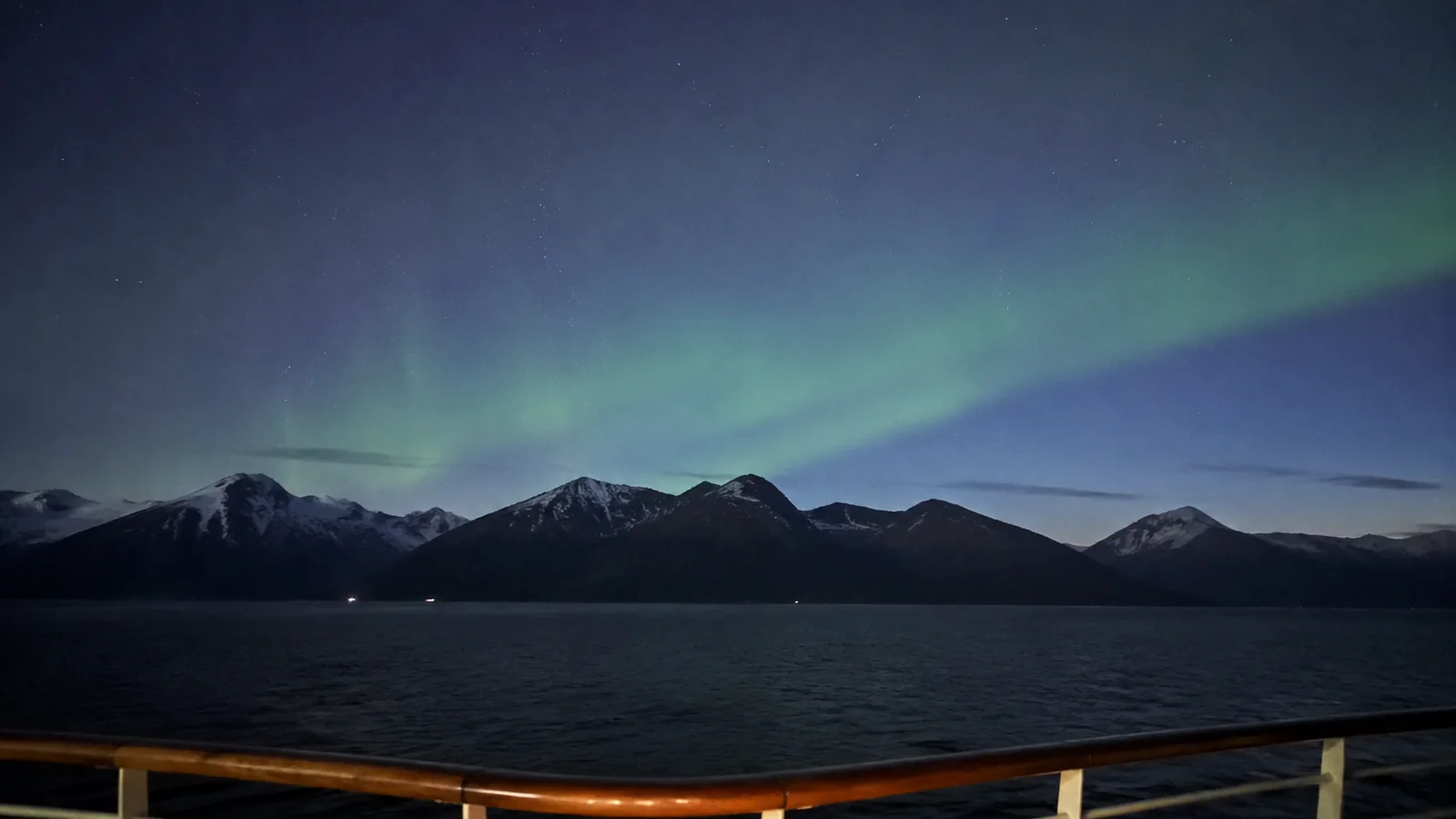
Yes, you can see the northern lights on an Alaska cruise, but no sailing can promise them. Your best realistic chance comes on a late-August or September itinerary with true darkness, a clear sky, favorable solar activity, and a viewing place away from the ship’s brightest lights.
The honest answer: possible, never guaranteed
Aurora viewing needs several things to line up at the same time. Charged particles must produce activity in the right part of the sky, darkness must be sufficient, clouds must stay out of the way, and you must be awake with a usable view.
A cruise controls almost none of those ingredients. It can put you at northern latitudes and offer open horizons, but it cannot clear clouds, schedule solar activity, or switch off every safety light on deck.
That is why I would choose an Alaska cruise for glaciers, wildlife, scenery, and ports first. Treat the aurora as a marvelous bonus rather than the single event that determines whether the vacation succeeded.
When can you see the northern lights on an Alaska cruise?
Late August through September is the practical overlap between Alaska’s cruise season and the return of dark nights. Earlier summer sailings may travel beneath an active aurora, but the bright sky can make it invisible.
The National Park Service says June and July are too bright for aurora viewing in Denali, while darkness returns around mid-August. The University of Alaska Fairbanks describes Fairbanks’ main viewing season as roughly August 21 through April 21, with brief twilight possibilities around the edges.
Most conventional Alaska cruises operate between May and September, with a smaller number outside that window. Travel Alaska’s official cruise overview notes that some lines extend into April and October, but an October date should never be assumed to exist for your preferred route.
May, June, and July
These months are poor choices if seeing the aurora is your main goal. Long daylight and lingering twilight are the problem, not a lack of auroral activity above the atmosphere.
You may enjoy generally longer sightseeing days, seasonal wildlife opportunities, and fuller cruise schedules instead. Our month-by-month Alaska cruise guide helps weigh those benefits against the absence of useful darkness.
Late August
Late August is the first sensible compromise for many cruise travelers. Nights become darker, yet the season still offers more sailings and daylight for ports than its final weeks.
A departure during the last third of the month is more promising than an early-August sailing, especially farther north. Darkness changes quickly with date and latitude, so compare the exact sunset and twilight times for your route.
September
September usually offers the strongest aurora opportunity within the mainstream Alaska cruise calendar. It also brings cooler conditions, more darkness, changing seasonal schedules, and a greater need for flexible weather expectations.
Our guide to an Alaska cruise in September covers the broader tradeoffs. Do not book the last available sailing solely because it is darker, since route quality and port time still matter.
October
An occasional October sailing can provide long nights, but choices are limited and weather can be more challenging. Some visitor services and excursions will also have ended for the year.
Verify every port, scenic-cruising day, and transfer rather than assuming a late itinerary mirrors a July one. A darker cruise with an uninspiring route is not automatically a better Alaska vacation.
Why Fairbanks offers better odds than the ship
Fairbanks lies in Interior Alaska beneath the auroral zone and has a drier continental climate than much of the Southeast coast. It also offers the enormous advantage of several consecutive nights in one place.
The University of Alaska Fairbanks says clear or partially clear skies are required and notes that continental locations in Alaska tend to have clearer skies. Its aurora forecast and viewing guidance is an excellent planning source, but even it never promises a display.
A one-way Gulf of Alaska cruise ending at Whittier or Seward can connect with Anchorage, Denali, and Fairbanks by land. This gives you a normal cruise plus two or three Interior nights that are far more useful for focused aurora watching.
Round-trip Inside Passage cruises generally remain in Southeast Alaska and return to Seattle or Vancouver. They can deliver a sighting in late season, but they do not take the ship to Fairbanks, which is inland and hundreds of miles from the cruise ports.
Which Alaska cruise route is best?
One-way Gulf cruise with a Fairbanks stay
This is the best overall setup when aurora matters enough to shape the trip. Choose a northbound or southbound voyage between Vancouver and Seward or Whittier, then add several land nights in Interior Alaska.
Build the land segment around actual transportation and seasonal operations, not a straight line on the map. The Alaska Railroad and motorcoach schedules change by season, and Denali services wind down as fall advances.
Late-season Inside Passage round trip
This is the easiest option for travelers who want one ship and one round-trip homeport. Ketchikan, Sitka, Juneau, Skagway, and the channels between them sit far enough north for possibilities once darkness returns.
The compromise is coastal cloud and a rigid nightly sailing schedule. Southeast Alaska weather can hide a strong display completely, while port departures and narrow-channel navigation may restrict where passengers can stand.
Small-ship Alaska cruise
A small ship may reach quieter anchorages with less surrounding city light, but that does not make the sky cooperate. Outdoor access, onboard announcements, itinerary dates, and overnight navigation policies vary by operator.
Ask direct questions before booking: Will staff announce aurora activity, which decks remain open overnight, and can announcements reach your cabin? Compare those answers with the route tradeoffs in our small-ship Alaska cruise guide.
What creates a visible aurora?
The aurora forms when energetic particles interact with gases in Earth’s upper atmosphere, guided by its magnetic field. What travelers see depends on the auroral oval and current geomagnetic conditions, not simply how cold the night feels.
NOAA says the best observing region is generally an oval around high northern latitudes. Its official viewing tips say the most active viewing period is often within an hour or two of midnight, though stronger activity can expand that window.
Cloud is a complete visual barrier because the aurora occurs far above ordinary weather. A dazzling forecast means little when low clouds cover the route.
Moonlight does not make aurora impossible, and a bright display can remain impressive under the moon. Artificial light on the ship, however, can reduce your night vision and wash out faint structure.
How to read an aurora forecast without fooling yourself
Use the NOAA Space Weather Prediction Center and University of Alaska Fairbanks as your primary tools. Social posts can alert you to excitement, but old screenshots, broad maps, and camera-enhanced images are not a forecast for your deck.
The Kp index describes global geomagnetic activity on a scale from 0 to 9. A higher number can push visible aurora farther south, but Kp alone does not tell you whether the ship is under clear sky or whether activity will peak while you are outdoors.
Short-term forecasts become more useful close to viewing time. Check space weather, then compare it with the National Weather Service forecast for the ship’s approximate region and whatever cloud information the onboard team provides.
Do not chase one precise minute from a multiday model. Set a reasonable watch window, keep checking the whole sky, and be prepared for activity to strengthen, fade, or never appear.
How to watch from a cruise ship
Ask guest services on embarkation day whether the bridge announces aurora sightings and whether you must opt in by phone, television, app, or cabin setting. Never assume an announcement will wake you.
Find an open deck during daylight so you know the safest route from your cabin. At night, obey every closure and crew instruction because wind, wet decks, darkness, and navigation operations can make a favorite viewpoint unsafe.
- Protect night vision: Dim your phone and avoid using a bright flashlight around other viewers.
- Block stray light: Use your body or a solid structure to shield your eyes from deck fixtures without entering a closed area.
- Look beyond green: A faint aurora can resemble a pale gray arc or cloud to the eye before a camera reveals stronger color.
- Watch patiently: Give your eyes time to adjust and scan north, overhead, and across the horizon.
- Stay warm: Add windproof outerwear, a warm hat, gloves, and dry footwear even when the daytime forecast looks mild.
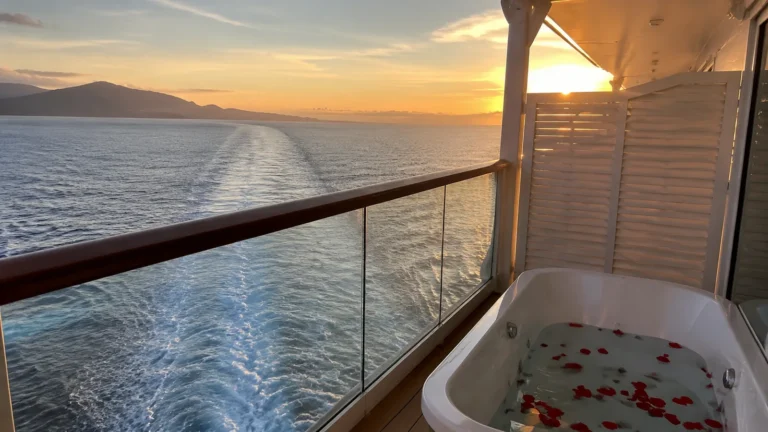
A private balcony sounds ideal, but its orientation may face away from the display and nearby lights can interfere. An accessible public deck with a broad view is usually more useful than paying extra solely for aurora watching.
What to pack for late-night viewing
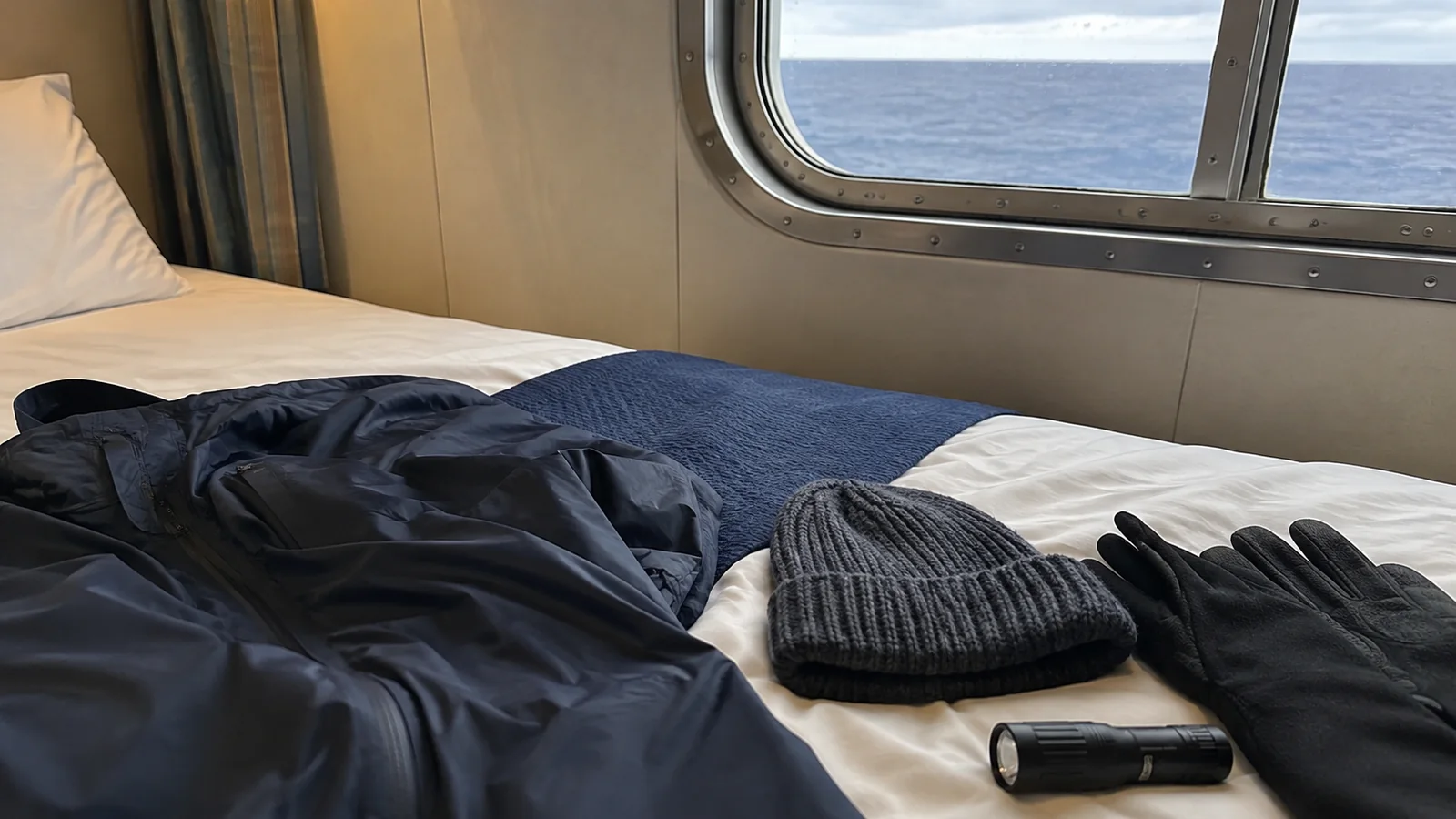
Bring a waterproof shell, insulating midlayer, warm base layer, hat, gloves, and shoes with useful grip. Our Alaska cruise outfit guide explains how to layer without packing a second closet.
For a phone, use night mode, steady it against a railing or compact tripod where permitted, and turn off the flash. A camera can record more color than your eyes, so enjoy the sky instead of judging the experience only through a screen.
Bring binoculars for wildlife, not aurora. The naked eye gives you the scale and movement, while a wide-angle lens is more useful for photographs.
Should you book an aurora excursion?
A cruise-port evening tour only makes sense when the ship stays late enough and the excursion has a safe return plan. Many Alaska port calls finish before prime darkness, especially earlier in the season.
A land-based tour from Fairbanks can provide transportation to darker skies, local monitoring, and warm shelter. It still cannot guarantee clear weather or activity, so read cancellation rules and treat “aurora guarantee” language as a contract term that may offer a retry rather than a sighting.
Two or three independent nights beat one tightly scheduled attempt. If aurora is a true priority, invest in time rather than the fanciest single-night package.
Common Alaska cruise aurora mistakes
- Booking June for the lights: High-latitude summer twilight is too bright even when aurora occurs.
- Confusing latitude with certainty: A northern position cannot overcome solid cloud.
- Assuming the ship visits Fairbanks: Fairbanks requires a separate inland journey.
- Trusting a long-range forecast: Exact activity and cloud details are most useful close to the viewing night.
- Staying indoors for an alert: Some ships announce sightings and others keep quiet overnight.
- Expecting camera color: A phone may show vivid green while a faint display looks silvery to your eyes.
Is an Alaska northern lights cruise worth it?
It is worth it when you already want an Alaska cruise and can travel in late August or September. Choose a strong itinerary, accept the cooler and darker season, and let the aurora be an extra reason to look outside at midnight.
If seeing the lights is the trip’s main purpose, combine a one-way Gulf cruise with at least three nights near Fairbanks or plan a winter land vacation instead. The cruise is the scenic journey, while repeated dark nights create the better aurora strategy.
No responsible guide can promise what the sky will do. You can only stack the odds with darkness, location, clear weather, multiple attempts, and the willingness to leave a warm bed when the alert finally comes.