Cruising Milford Sound: Routes, Access and Booking Checks
A Milford Sound cruise is only one part of the plan. Choose the right cruise format, confirm Piopiotahi access, check live Milford Road and weather conditions, and leave enough time to enjoy the fiord without turning a beautiful day into a race.
First, choose the experience you actually want
“Cruising Milford Sound” can describe three very different trips. Large cruise ships sail through as part of a New Zealand itinerary, local boats make shorter return trips from Milford Sound, and overnight vessels stay after most day visitors leave.
- Large-ship scenic cruising: easiest for cruise passengers, but you normally stay aboard and do not explore the road or shore.
- Local day cruise: the best close-range look at the cliffs, waterfalls, and mouth of the fiord, but reaching the terminal is a major part of the day.
- Coach-cruise day: the sensible first choice from Te Anau and often the least stressful choice from Queenstown.
- Overnight cruise: the quietest version, with higher cost, limited inventory, and more time exposed to schedule changes.
- Fly-cruise combination: the fastest option from Queenstown when conditions cooperate, but also the most weather-dependent.
My strongest recommendation is simple: do not compare these choices by cruise price alone. Compare the entire day, including road or flight time, parking, meals, cancellation terms, and how much scenery you see beyond the boat.
Milford Sound is a fiord, not a conventional cruise port
Piopiotahi/Milford Sound lies within Fiordland National Park in the southwest of New Zealand’s South Island. Glaciers carved the steep-sided inlet, which is why “fiord” is geographically accurate even though “Sound” remains the familiar place name.
This is not a port city with a walkable restaurant district and taxis waiting beside a large cruise pier. The small visitor area serves local tour boats and road arrivals, while big ships experience the landscape from the water.
If this stop is one piece of a longer voyage, start with the route and season advice in my New Zealand cruise itinerary guide. Milford is a superb scenic component, but it should not distract you from port time, Tasman Sea days, and the direction of the full sailing.
Large cruise ships offer scenic cruising, not a port day
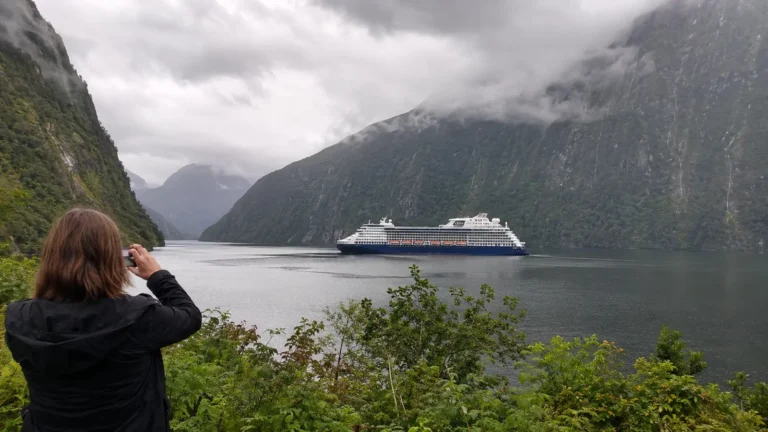
On a typical mainstream itinerary, Milford Sound appears as scenic cruising rather than a docked call. Princess states directly that its ships do not dock or embark passengers inside the fiords, and describes Milford, Doubtful, and Dusky as scenery viewed from the ship on its current Fiordland page.
Treat wording such as “Milford Sound,” “Fiordland cruising,” or “cruise by” as a cue to inspect the day-by-day schedule. Unless your cruise line explicitly sells a landing or overland arrangement, do not plan to step ashore.
What the large-ship experience does well
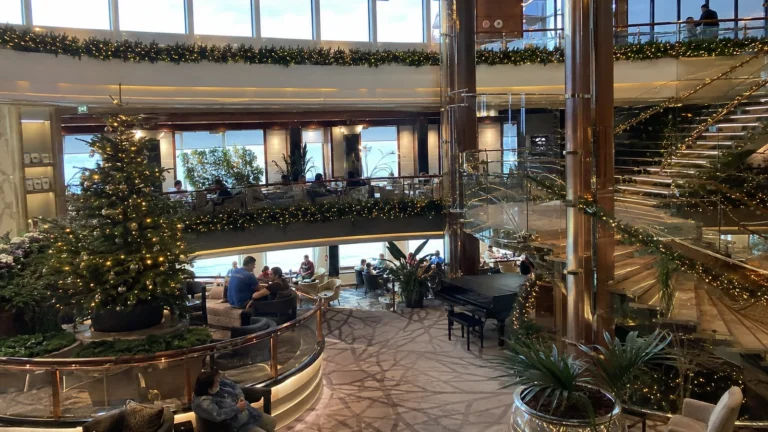
A big ship gives you elevated views, warm indoor lounges, accessible restrooms, food, and the freedom to move between viewing areas. It can also combine Milford with Doubtful and Dusky sounds during one scenic sequence, something a standard Milford day boat does not do.
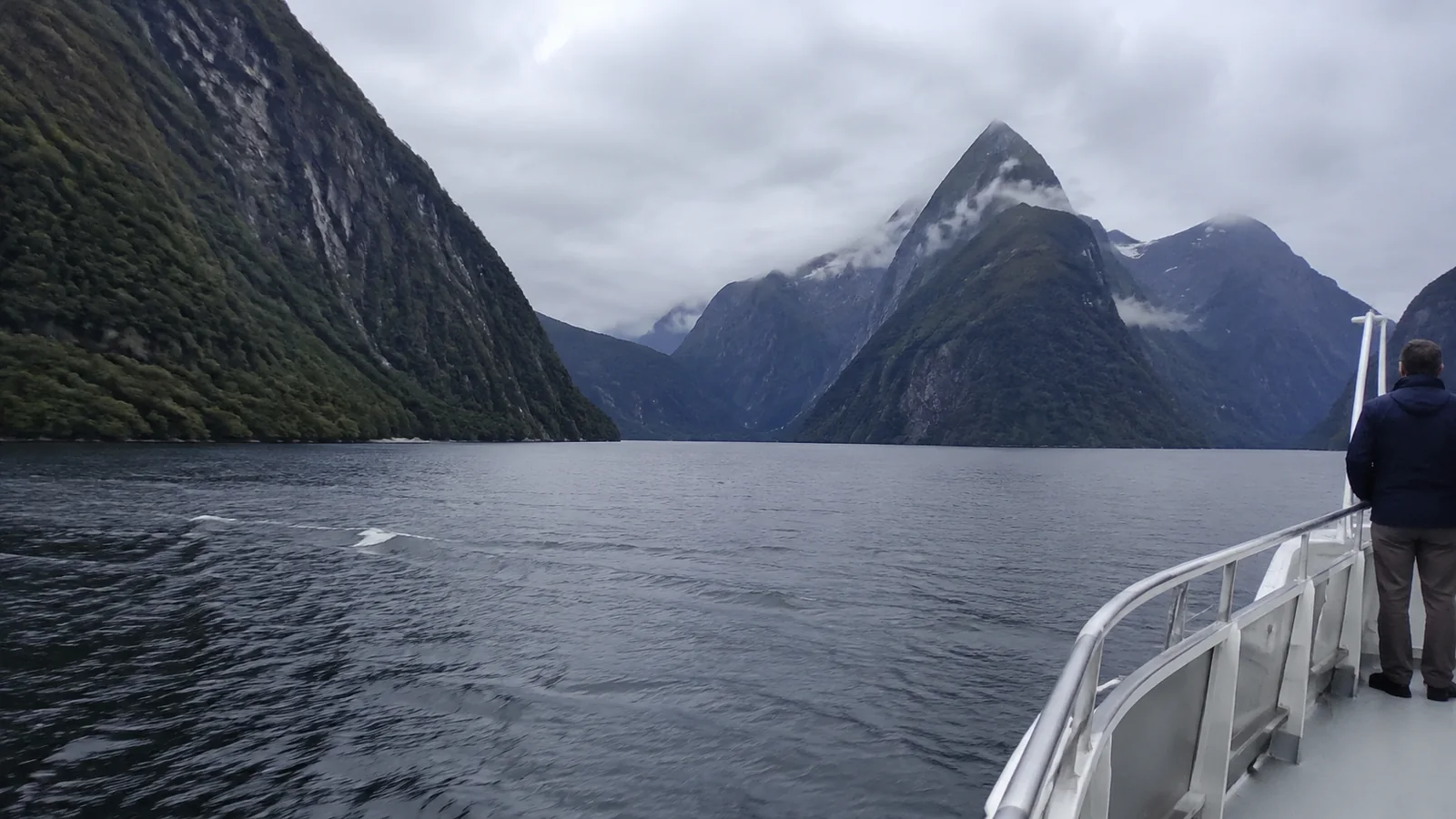
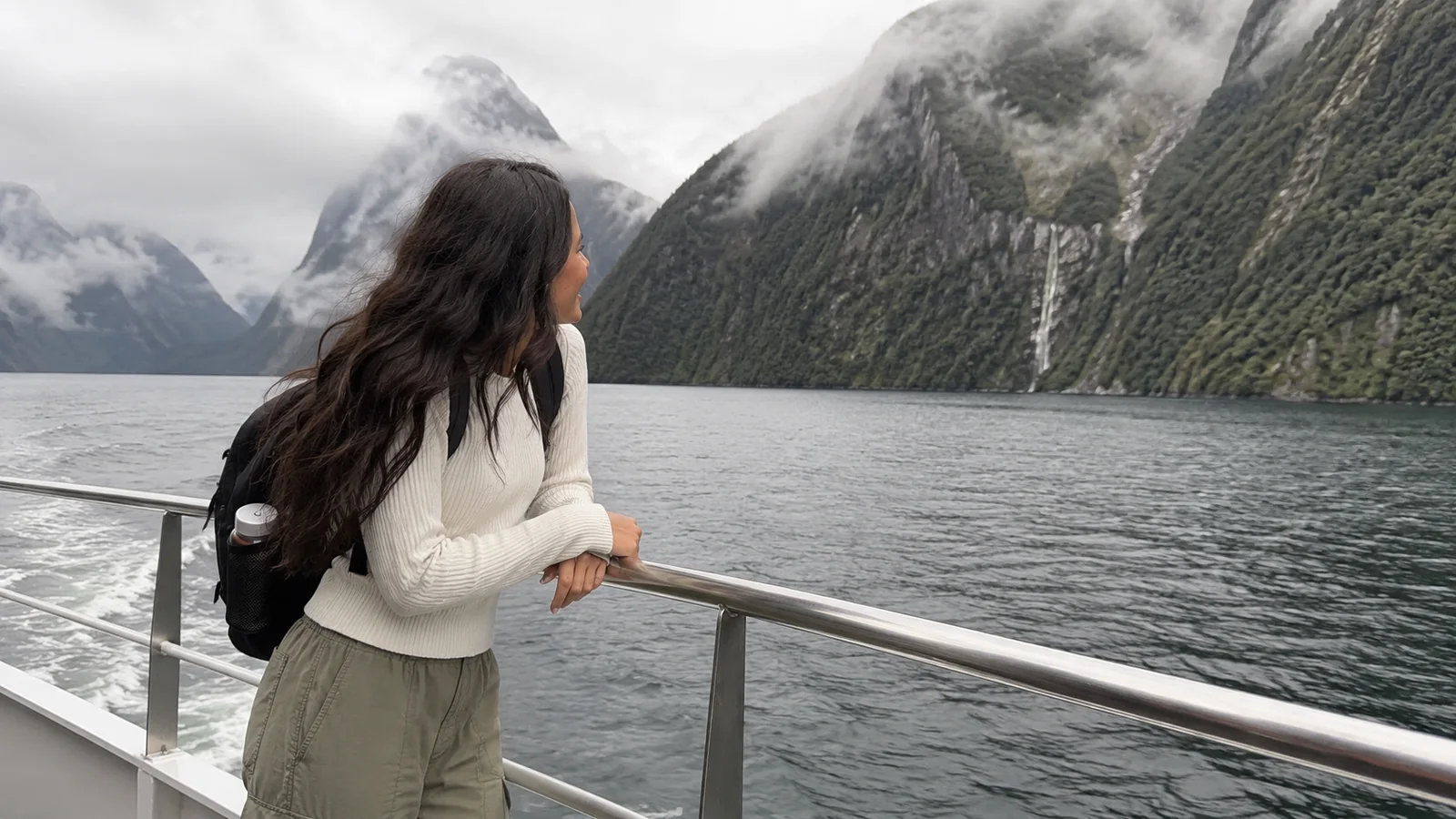
The scale is the reward: cliffs seem to close around a vessel that felt enormous in open water. The compromise is distance, because a local boat can usually approach features more closely and turn its entire short itinerary around this one fiord.
Choose your viewing place before the ship arrives
Do not assume your balcony is automatically the best seat. An open upper deck or forward observation lounge can provide a broader angle and lets you switch sides as the ship turns.
Balconies are valuable when the weather is wet, the rails become crowded, or mobility makes repeated deck changes difficult. If your cabin has a sheltered or partly obstructed view, identify public alternatives the day before.
Bring binoculars, a lens cloth, a waterproof phone cover, and a warm shell to the deck. Commentary may identify peaks and wildlife, but animals are never scheduled entertainment.
Scenic cruising can change
Wind, visibility, sea state, operational limits, and the master’s safety judgment can alter the route or cancel an entry. A printed itinerary is an intention, not a guarantee that the ship will reach every advertised viewpoint.
I would not book a New Zealand cruise solely because one line on the schedule says Milford Sound. Choose an itinerary you would still value if Fiordland becomes a distant view or a missed scenic day.
A local day cruise gives you the closest practical look
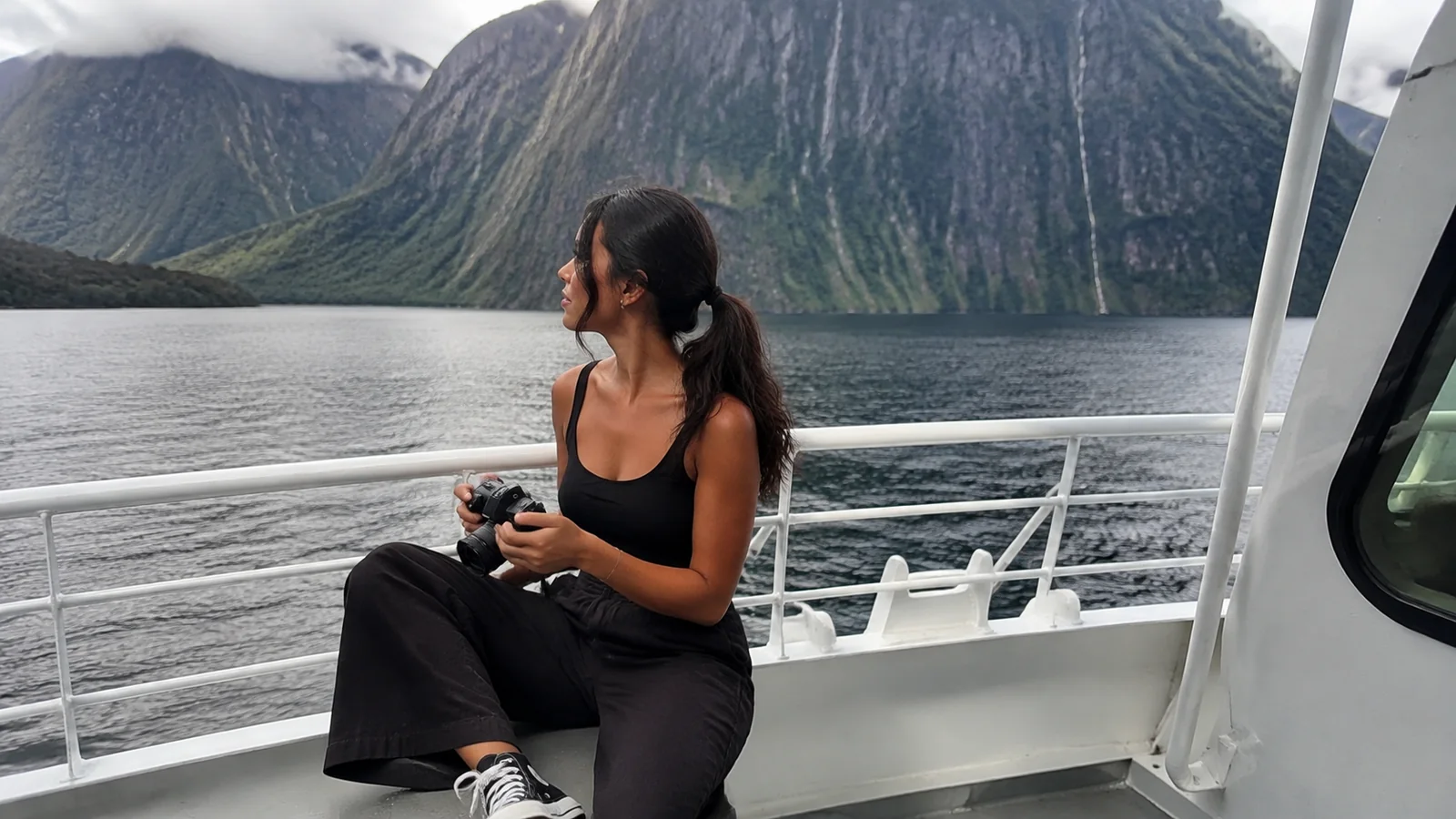
Local cruises leave from the Milford Sound terminal, travel toward the Tasman Sea, and return to the same place. The destination’s official cruise overview says the average day cruise lasts about 1 hour 45 minutes, while some longer products reach roughly 2.5 hours.
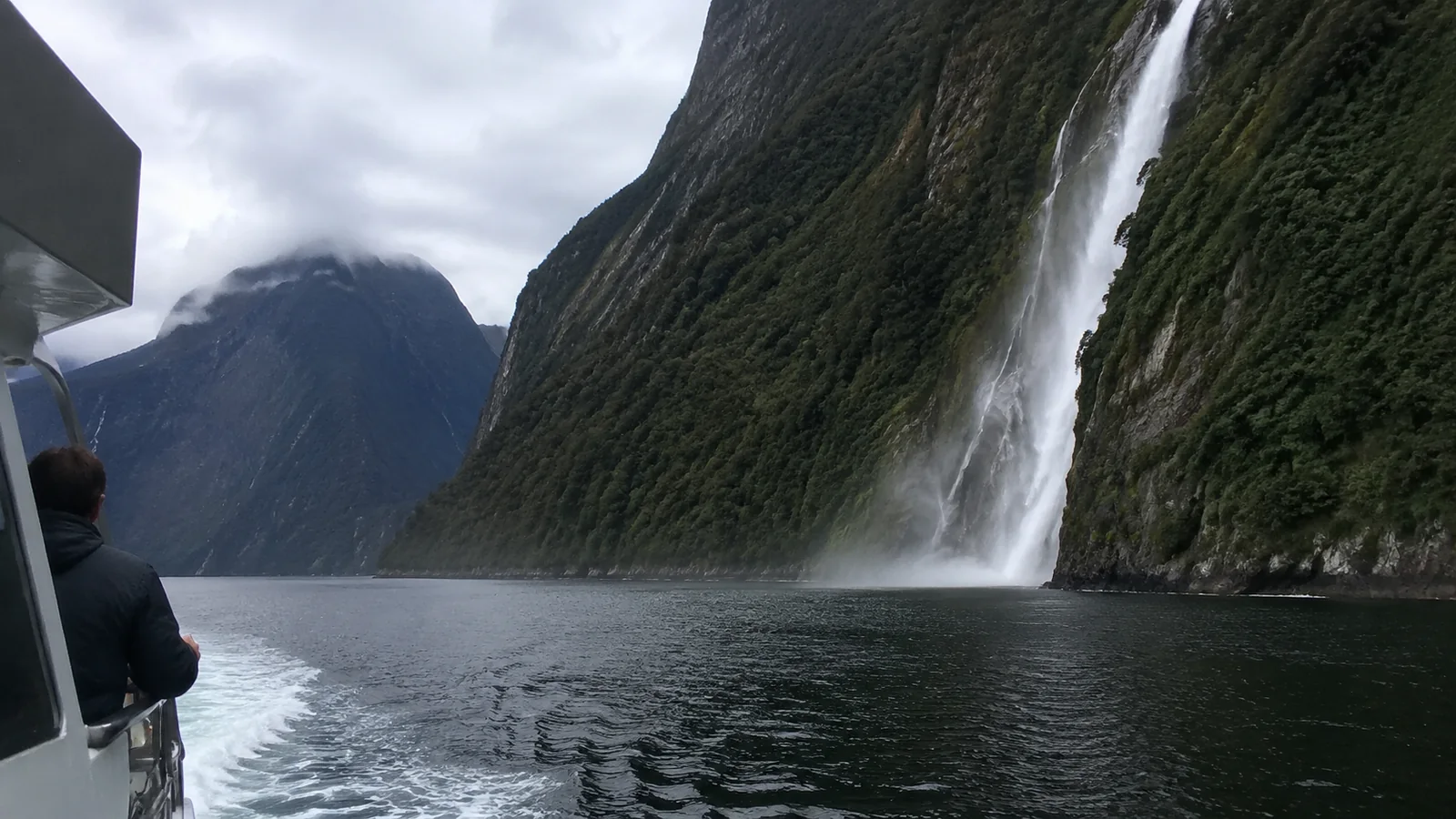
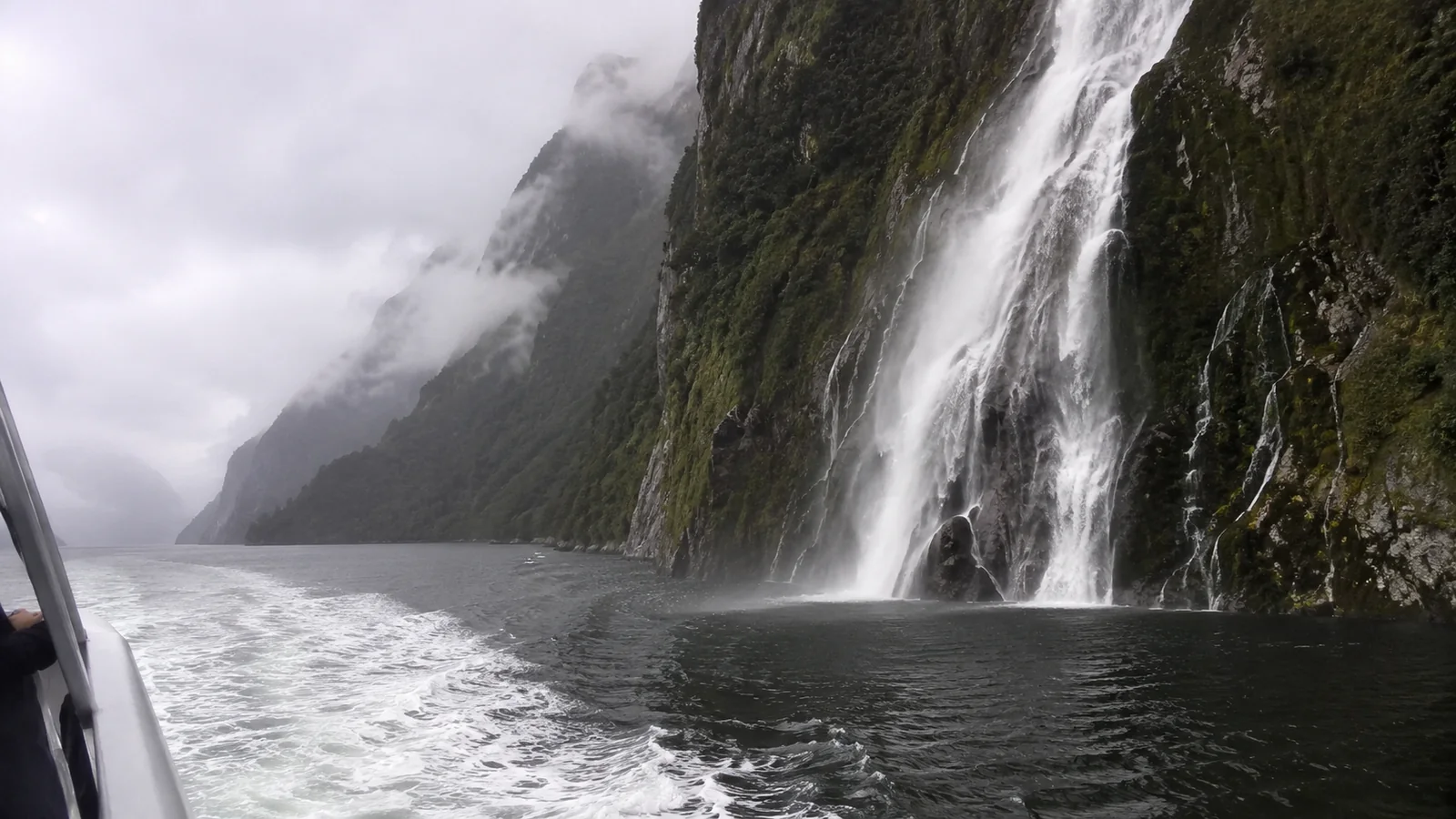
Boats pass prominent features such as Bowen Falls, Mitre Peak, Stirling Falls, Seal Rock, and the fiord entrance, although route details remain subject to conditions. Selected products may add an underwater observatory, kayaking, food, or a smaller-vessel emphasis.
How to compare local boats
Start with departure time and total duration, then compare vessel size, indoor seating, exposed deck space, commentary, food, mobility access, child policies, and included add-ons. “Nature cruise” and “scenic cruise” are marketing labels, so the actual boat and inclusions matter more than the name.
A smaller boat may feel more intimate and maneuver nearer certain features, but it may also offer less indoor space and more motion. A larger local boat can be comfortable for mixed-age groups, yet carries more people and can feel busier at the rail.
Ask whether check-in is at the terminal, how early it closes, and what happens if Milford Road delays your arrival. A cheap nonrefundable departure is poor value if its timing leaves no road buffer.
Wildlife needs honest expectations
New Zealand fur seals, dolphins, seabirds, and seasonal Fiordland crested penguins may appear. No ethical operator can guarantee that wild animals will be visible on a particular sailing.
I would choose a cruise for the landforms and waterfalls, then treat wildlife as a bonus. That produces a much better value test than paying extra for a promise nature cannot keep.
Is an overnight cruise worth it?
An overnight places you on the water during quieter evening and morning periods, and packages may include dinner, breakfast, kayaking, or tender excursions. It suits travelers who want the fiord itself to be the centerpiece rather than one stop on a rapid South Island loop.
The tradeoffs are a much higher fare, a fixed overnight schedule, limited cabins, and continued weather exposure. Verify private versus shared bathrooms, luggage limits, activity requirements, child restrictions, meals, transport, and cancellation rules before paying.
Do not confuse a Milford overnight with an overnight in Doubtful Sound. They are different waterways with different access chains, and my Doubtful Sound planning comparison explains why its lake and pass transfer makes it a separate trip.
Te Anau is the best road base
For most independent travelers, Te Anau is the practical base for a Milford day. The Department of Conservation says the Te Anau to Milford return is 144 miles and advises allowing eight hours when stops, short walks, and a boat cruise are included in its Milford Road guidance.
That estimate is not four hours of spare time around a two-hour boat. It accounts for a narrow alpine road, scenic stops, traffic, check-in, and the reality that the journey is part of the attraction.
I would stay in Te Anau the night before and, when possible, the night after. That protects an early cruise, reduces driver fatigue, and gives road closures more room to rearrange the plan.
Queenstown is possible, but it is a very long day
DOC puts the Queenstown return at about 360 miles and 12 to 14 hours, and recommends planning the return trip from Te Anau instead. The map looks manageable until winding roads, stops, weather, and a fixed boat departure enter the calculation.
A coach-cruise package is the more responsible choice for many Queenstown visitors because nobody in your party must drive both ways after a long sightseeing day. Confirm pickup time, vehicle type, toilet stops, lunch, cruise operator, and expected return rather than buying from a headline photo.
A scenic flight can reduce travel time and add aerial views, but low cloud, wind, and rain can interrupt flying even when boats operate. Read the weather-cancellation, refund, rebooking, and ground-return terms before building a same-day connection around it.
Self-driving Milford Road requires a real buffer
State Highway 94 is spectacular, remote, and operationally sensitive. Check the New Zealand Transport Agency Milford Road status before departure and again that morning for closures, avalanche control, snow, ice, and chain instructions.
There are no shops or fuel stations between Te Anau and Milford Sound, and mobile coverage is limited outside Te Anau. Fill the tank, download maps, carry food and water, and do not count on a roadside signal to solve a late arrival.
The Homer Tunnel is about 0.75 mile long, has a steep gradient toward Milford, and can operate with traffic lights during peak periods. Treat posted restrictions and no-stopping zones as safety controls, not optional sightseeing advice.
Winter and shoulder-season driving
From May through September, snow, ice, freezing shade, and avalanche risk can make the road far more demanding. Chains may be required, and carrying them is useful only if you know how to fit them correctly.
If you lack alpine driving experience, book a coach or change the plan. A paid cruise does not justify continuing onto a road when official advice, closures, or your own confidence says stop.
Rain changes the view, not the need for caution
Milford is famous for rain, and fresh water can produce temporary ribbons of waterfalls across the cliffs. Rain can also reduce visibility, soak exposed decks, complicate photography, and contribute to road or flight disruption.
Use the official MetService Milford Sound forecast for the short-range outlook. A generic Queenstown forecast is not a substitute for conditions on the coast or the alpine road.
Pack a waterproof and windproof shell, warm midlayer, secure hat, non-slip shoes, and a dry pouch for electronics even in summer. An umbrella is awkward on a moving deck and much less useful than clothing that leaves both hands free.
For a big-ship visit, keep those layers in your cabin rather than packed in checked luggage. The best outdoor viewing may occur early, late, or with little warning as the ship changes position.
Accessibility, children, and motion
Local vessel access varies by boat, berth, tide, and mobility equipment. Contact the operating company, not only a reseller, with wheelchair dimensions, transfer ability, step tolerance, and restroom needs before booking.
Families should confirm stroller storage, child pricing, rail rules, food, and required supervision. The drive can be harder for young children than the cruise itself, so build in safe stops and avoid an itinerary that depends on perfect naps.
The sheltered fiord can be calmer than open ocean, but motion is still possible, especially near the Tasman Sea. Travelers prone to motion sickness should discuss suitable medication with a clinician or pharmacist before the day and follow label directions.
Leave time for the shore without overplanning it
Road visitors can add a short foreshore walk or lookout when conditions, parking, and cruise timing allow. Keep the plan light because the main value lies in the road and water, not in collecting a long list of tiny stops.
Stay on marked public routes, carry out waste, never feed kea, and follow conservation signs. This is a living national park and culturally significant place, not a scenic set built around visitor schedules.
Do not casually add an alpine route such as Gertrude Saddle to a cruise day. Technical terrain, wet rock, snow, avalanche exposure, and rapidly changing weather make serious hikes a separate objective that requires the right skills and conditions.
How to book the right Milford Sound cruise
Book only after the transport chain makes sense. A local boat reservation is incomplete until you know where you will sleep, how you will reach the terminal, and what happens if the road or flight fails.
- Confirm whether the itinerary is large-ship scenic cruising or a local boat departure.
- Check the operating company, exact vessel, duration, check-in cutoff, and terminal.
- Compare indoor seating, outdoor access, commentary, meals, and restroom arrangements.
- Verify wheelchair, stroller, child, and mobility details directly with the operator.
- Read cancellation terms for weather, road closures, missed check-in, and flight disruption.
- Check SH94 status and the Milford forecast close to departure.
- Build a generous return margin before any flight, ferry, tour, or cruise embarkation.
Peak summer dates merit advance booking, but flexibility has value in a weather-sensitive destination. I would pay slightly more for workable change terms before choosing a rigid bargain tied to an aggressive driving schedule.
My final recommendation
If you are already taking a New Zealand cruise, scenic cruising through Fiordland is a compelling itinerary feature and the easiest way to see several remote sounds. It is not the same as a local Milford boat, a Milford Road journey, or time ashore.
For a land trip, base in Te Anau, choose a local day cruise or overnight, and treat the road as part of the experience. Travelers deciding whether scenery should drive the whole vacation can also compare the landscape priorities in my best cruise destinations guide.
The strongest Milford plan has one ambitious element and plenty of margin. Let the mountain road, marine conditions, and weather set the pace, because forcing too much into this remote corner of New Zealand is the quickest way to miss what makes it special.